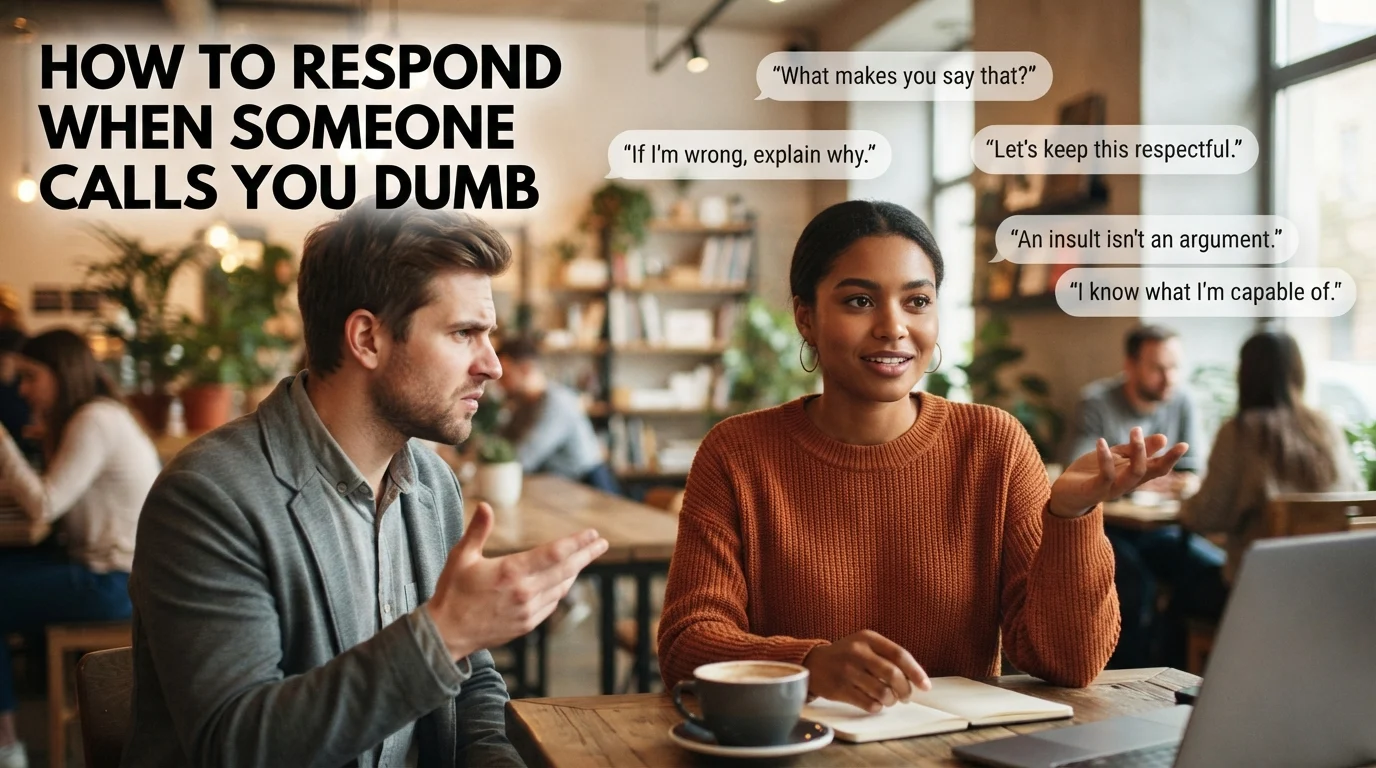
Knowing how to respond when someone calls you dumb can be difficult, especially when the comment catches you off guard. Being called “dumb” can feel insulting, but reacting impulsively may turn a small comment into a bigger argument. A thoughtful response can help you protect your confidence without unnecessarily escalating the situation.
The right comeback depends on who said it, why they said it, and how serious the situation is. You might want a calm response that sets a boundary, a clever comeback that shows confidence, or a funny reply that keeps things light. Here are practical ways to respond when someone questions your intelligence or tries to put you down.
1. “What Makes You Think That?”
This simple question makes the other person explain their comment instead of allowing the insult to stand on its own.
Best for: Calmly challenging an unfair insult.
Alternative: “What makes you say that?”
Examples:
“What makes you think I’m dumb?”
“What exactly did I say that gave you that impression?”
2. “You’re Entitled to Your Opinion.”
You do not have to convince everyone of your intelligence or worth.
Best for: When you do not want to argue.
Alternative: “That’s your opinion.”
Examples:
“You’re entitled to your opinion.”
“You can think that if you want.”
3. “I’d Rather Hear a Point Than an Insult.”
This response redirects the conversation toward something constructive.
Best for: Arguments or serious disagreements.
Alternative: “If you disagree, explain why.”
Examples:
“I’d rather hear your reasoning than an insult.”
“If you think I’m wrong, tell me where.”
4. “Being Wrong About Something Doesn’t Make Me Dumb.”
Everyone makes mistakes, misunderstands things, or gets answers wrong.
Best for: When someone uses one mistake to judge your intelligence.
Alternative: “Making a mistake is part of learning.”
Examples:
“I got something wrong, but that doesn’t define my intelligence.”
“Everyone makes mistakes.”
5. “You Can Disagree Without Insulting Me.”
This establishes a straightforward communication boundary.
Best for: Someone who regularly uses personal insults.
Alternative: “Let’s keep the conversation respectful.”
Examples:
“You can disagree with me without calling me names.”
“If we’re going to talk, let’s keep it respectful.”
6. “That’s Not a Very Intelligent Argument.”
This is a pointed response that focuses on the quality of the conversation rather than attacking the person’s identity.
Best for: Verbal sparring or heated disagreements.
Alternative: “That doesn’t really support your argument.”
Examples:
“Calling me dumb doesn’t prove your point.”
“An insult isn’t really an argument.”
7. “I’m Still Learning.”
This confident response removes some of the power from the insult.
Best for: Situations where you genuinely do not know something.
Alternative: “I don’t know everything, and that’s okay.”
Examples:
“I’m still learning, so I’m not embarrassed to ask questions.”
“I don’t know everything, but I’m willing to learn.”
8. “I Don’t Need to Know Everything.”
Nobody has complete knowledge.
Best for: When someone mocks you for not knowing something.
Alternative: “Nobody knows everything.”
Examples:
“I don’t know the answer, and that’s okay.”
“Not knowing something gives me a chance to learn it.”
9. “If You Know More, Teach Me.”
This turns an insult into an opportunity for constructive conversation.
Best for: Academic, professional, or informational situations.
Alternative: “Then explain it to me.”
Examples:
“If you know more about it, teach me instead of insulting me.”
“Show me what I’m missing.”
10. “Calling Me Dumb Doesn’t Make You Smarter.”
This is a confident comeback that points out the weakness of personal insults.
Best for: Someone trying to feel superior.
Alternative: “Putting someone down doesn’t prove anything.”
Examples:
“Calling me dumb doesn’t automatically make you smarter.”
“You don’t prove your intelligence by insulting someone.”
11. “I’m Comfortable Admitting When I Don’t Know Something.”
Intellectual confidence includes being willing to admit uncertainty.
Best for: Mature conversations.
Alternative: “I’m not afraid to say I don’t know.”
Examples:
“I don’t know everything, and I’m comfortable admitting that.”
“I’d rather ask a question than pretend I know.”
12. “You Don’t Have to Agree With Me.”
People can disagree without turning the disagreement into a personal attack.
Best for: Discussions and debates.
Alternative: “We can simply disagree.”
Examples:
“You don’t have to agree with me.”
“We see this differently, and that’s okay.”
13. “Let’s Focus on the Actual Issue.”
This response moves attention away from name-calling.
Best for: Heated arguments.
Alternative: “Let’s discuss the point instead.”
Examples:
“Let’s focus on what we’re actually discussing.”
“Calling me names isn’t going to solve the issue.”
14. “What’s Your Actual Point?”
This is direct and useful when the insult is being used instead of an explanation.
Best for: Someone who is avoiding the substance of a disagreement.
Alternative: “What are you actually trying to say?”
Examples:
“What’s your actual point?”
“If you think I’m wrong, explain why.”
15. “That Says More About the Conversation Than It Does About Me.”
This calm response refuses to accept the insult as a meaningful judgment.
Best for: Personal attacks.
Alternative: “I’m not going to define myself by your comment.”
Examples:
“That comment doesn’t tell me anything useful about myself.”
“I’d rather discuss facts than labels.”
16. “Maybe Explain Instead of Insulting.”
Sometimes the other person may actually have a valid criticism but communicate it poorly.
Best for: When you are open to feedback.
Alternative: “Tell me what I got wrong.”
Examples:
“Maybe explain what I got wrong instead of calling me dumb.”
“If I made a mistake, show me where.”
17. “I’ll Take the Lesson, Not the Insult.”
This response separates useful criticism from unnecessary name-calling.
Best for: Constructive situations.
Alternative: “I can accept feedback without accepting disrespect.”
Examples:
“I’ll listen to useful feedback, but I don’t need the insult.”
“Tell me what I can improve.”
18. “That Was Unnecessary.”
Sometimes you do not need a clever comeback. Simply identifying inappropriate behavior can be effective.
Best for: Friends, coworkers, family, or acquaintances.
Alternative: “You didn’t need to say that.”
Examples:
“That was unnecessary.”
“You could have made your point without saying that.”
19. “I’m Not Going to Argue About My Intelligence.”
You do not have to defend your intelligence every time someone makes a negative comment.
Best for: Ending repetitive arguments.
Alternative: “I don’t need to prove myself to you.”
Examples:
“I’m not going to argue about whether I’m smart enough.”
“I know what I’m capable of.”
20. “Interesting Choice of Words.”
This short response can make the other person reconsider what they said.
Best for: Calm, confident situations.
Alternative: “That’s an interesting way to communicate.”
Examples:
“Interesting choice of words.”
“That’s quite a way to make your point.”
21. “I’d Rather Be Curious Than Pretend to Know Everything.”
Curiosity is not the opposite of intelligence.
Best for: When someone mocks you for asking questions.
Alternative: “Asking questions is how people learn.”
Examples:
“I’d rather ask questions than pretend I know everything.”
“Curiosity isn’t something I’m ashamed of.”
22. “You’re Confusing Not Knowing With Not Being Capable.”
Someone may not know a particular fact or skill while still being perfectly capable.
Best for: When someone judges you based on one weakness.
Alternative: “Not knowing something doesn’t mean I can’t learn it.”
Examples:
“I may not know this yet, but I can learn it.”
“Lack of experience isn’t the same as lack of ability.”
23. “I’ll Let My Actions Speak.”
This confident response avoids getting trapped in a verbal argument.
Best for: Work, school, or competitive situations.
Alternative: “You’ll see what I can do.”
Examples:
“I don’t need to argue about it. I’ll let my work speak.”
“I’d rather demonstrate what I can do.”
24. “You Can Think That. I Know Myself.”
This works when someone is making a personal judgment rather than offering useful feedback.
Best for: Personal conversations.
Alternative: “Your opinion doesn’t define me.”
Examples:
“You can think that, but I know who I am.”
“I’m not going to let one comment define me.”
25. “If I’m Missing Something, Help Me Understand.”
This is a mature response when you genuinely want to resolve the disagreement.
Best for: Serious discussions.
Alternative: “Tell me what I’m missing.”
Examples:
“If I’m missing something, help me understand.”
“Explain your reasoning and I’ll listen.”
26. “That’s Not How Respectful People Communicate.”
This clearly identifies the behavior as inappropriate.
Best for: Repeated disrespect.
Alternative: “We can communicate without name-calling.”
Examples:
“That’s not a respectful way to speak to someone.”
“If we’re going to continue, please leave the name-calling out.”
27. “I’m Not Interested in Trading Insults.”
This is a useful boundary when someone wants to turn the conversation into a battle.
Best for: Arguments that are becoming hostile.
Alternative: “I’m not playing that game.”
Examples:
“I’m not interested in trading insults.”
“If this is going to become a name-calling contest, I’m leaving.”
28. “Maybe We Should Take a Break From This Conversation.”
Sometimes stepping away is more productive than finding the perfect comeback.
Best for: Heated situations.
Alternative: “Let’s talk when we’re both calmer.”
Examples:
“I think we should take a break and come back to this later.”
“This conversation isn’t productive right now.”
29. “That’s Fine. I Don’t Need Your Approval.”
This response shows independence without requiring another argument.
Best for: Casual or personal criticism.
Alternative: “You don’t have to approve of me.”
Examples:
“That’s fine. I don’t need everyone to agree with me.”
“You’re allowed to have your opinion, and I’m okay with that.”
30. “Let’s Talk About the Issue, Not Attack Each Other.”
This is a strong all-purpose response because it keeps the focus on productive communication.
Best for: Serious disagreements where you want to resolve the actual problem.
Alternative: “Let’s discuss the facts instead of making it personal.”
Examples:
“Let’s talk about what happened instead of attacking each other.”
“If there’s a problem, I’m willing to discuss it respectfully.”
FAQs
What is a good response when someone calls you dumb?
A calm response such as “What makes you say that?” or “If you think I’m wrong, explain why” can shift the conversation away from insults and toward the actual issue.
How do you respond to being called dumb without being rude?
Avoid returning the insult. Try saying, “You can disagree with me without insulting me,” or “I’m willing to hear your criticism if you explain it respectfully.”
What is a clever comeback when someone calls you dumb?
You could say, “Calling me dumb doesn’t prove your point,” or “An insult isn’t really an argument.” These responses challenge the comment without relying on personal attacks.
Should you ignore someone who calls you dumb?
Sometimes ignoring the comment is the best response, particularly when the person appears to be trying to provoke you. If the relationship matters, calmly addressing the behavior may be more useful.
How can I stay confident when someone insults my intelligence?
Remember that one person’s comment does not establish your abilities. Focus on the specific issue, remain open to legitimate feedback, and avoid feeling pressured to prove yourself through an argument.
Conclusion
Learning how to respond when someone calls you dumb is less about finding the most devastating comeback and more about choosing a response that protects your confidence and keeps the situation under control. A calm question, clear boundary, or thoughtful explanation can often be more effective than returning the insult.
If the person has genuine criticism, give them an opportunity to explain it. If they are simply trying to provoke you, you do not have to participate. Knowing when to speak up, when to ask for clarification, and when to walk away is itself a valuable communication skill.

I’m Brianna Grace, an author at Replieds. I love creating thoughtful, practical replies that help people communicate naturally, confidently, and meaningfully in everyday conversations.