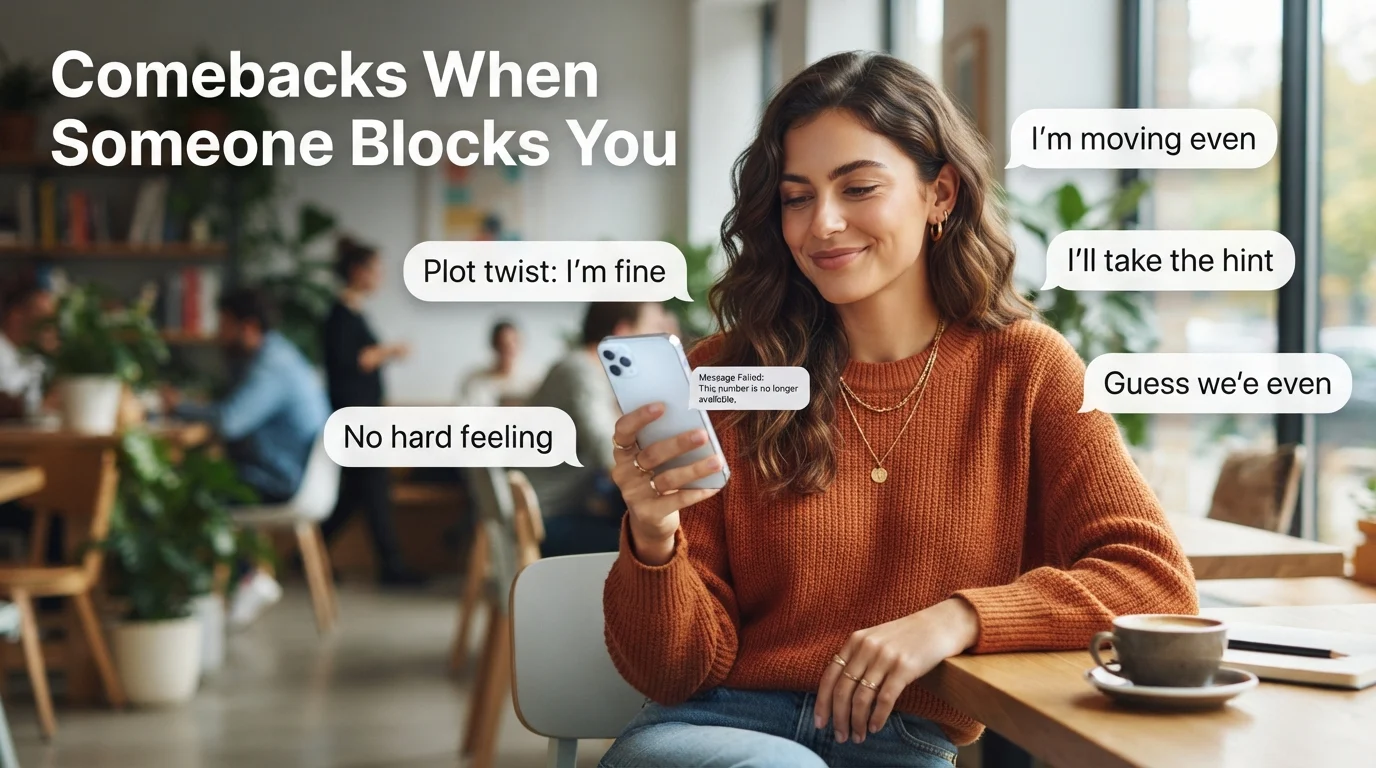
Getting blocked can feel confusing, especially when you have no idea what caused it. Whether it happened after an argument, a breakup, a disagreement, or simply out of nowhere, you may find yourself wondering what you could say if that person ever unblocks you—or what kind of comeback fits the situation.
The good news is that you don’t need to chase someone who blocked you. The best comebacks when someone blocks you can be funny, confident, sarcastic, or mature without becoming unnecessarily cruel. The key is to protect your dignity while letting your personality come through. Here are practical responses for different situations, from playful one-liners to calm and classy replies.
1. “Thanks for the Peace and Quiet”
Sometimes the best comeback is one that shows you’re completely unbothered.
Best for: Someone who blocked you after unnecessary drama.
Alternative: “Honestly, the silence is refreshing.”
Examples:
“Thanks for the peace and quiet. I needed it.”
“Your block button really improved my notifications.”
2. “I Guess I Got Promoted to Stranger”
Turn the situation into a lighthearted joke instead of taking it personally.
Best for: Friends or acquaintances with a playful relationship.
Alternative: “So we’re strangers now? Interesting.”
Examples:
“I guess I just got promoted to complete stranger.”
“From daily conversations to strangers—what a career move.”
3. “That Was Dramatic”
A short sarcastic response can work when someone blocked you over something minor.
Best for: Petty arguments or unnecessary reactions.
Alternative: “Well, that escalated quickly.”
Examples:
“Blocking me over that? A little dramatic.”
“I didn’t realize we were filming a season finale.”
4. “No Hard Feelings”
A mature response can be more powerful than an angry comeback.
Best for: Situations where you want to move forward peacefully.
Alternative: “I respect your decision.”
Examples:
“No hard feelings. I genuinely wish you well.”
“If blocking me gives you peace, I respect that.”
5. “I Respect the Exit”
This response acknowledges their choice without begging them to return.
Best for: Breakups or complicated relationships.
Alternative: “Everyone chooses their own way out.”
Examples:
“I respect the exit. Take care.”
“If that’s how you wanted to leave, I won’t stop you.”
6. “You Saved Me the Trouble”
A confident comeback can suggest that you weren’t planning to continue the conversation anyway.
Best for: Toxic conversations and repeated arguments.
Alternative: “You made that decision easy for both of us.”
Examples:
“You blocked me? You actually saved me the trouble.”
“Looks like you handled the goodbye for me.”
7. “Was That Your Grand Finale?”
Use humor when the blocking seems unnecessarily theatrical.
Best for: Friends or people who appreciate sarcasm.
Alternative: “Was the block button your mic drop?”
Examples:
“Was that your grand finale?”
“Blocking me and disappearing? Very cinematic.”
8. “I’ll Survive”
Sometimes confidence is all you need.
Best for: Showing that you’re not dependent on someone’s attention.
Alternative: “Don’t worry, I’ll manage.”
Examples:
“I’ll survive without the notifications.”
“I’m pretty sure I’ll recover from this.”
9. “The Block Button Works Both Ways”
If they unblock you later, you can make it clear that access to you isn’t automatic.
Best for: Someone who repeatedly blocks and unblocks you.
Alternative: “Access isn’t guaranteed anymore.”
Examples:
“The block button works both ways, you know.”
“You can unblock me, but that doesn’t mean I’m available.”
10. “You Must Really Like That Button”
A playful jab can highlight someone’s habit of blocking people.
Best for: Someone who blocks and unblocks frequently.
Alternative: “That button gets a lot of attention from you.”
Examples:
“You must really love that block button.”
“At this point, blocking me is your favorite hobby.”
11. “I Thought You Wanted Attention”
This can work when someone blocks you immediately after trying to provoke a reaction.
Best for: Petty social-media drama.
Alternative: “Interesting way to ask for attention.”
Examples:
“I thought you wanted attention, not silence.”
“Blocking me right after starting drama is certainly a strategy.”
12. “No Audience, No Drama”
Sometimes refusing to participate is the strongest response.
Best for: Online arguments and social-media conflicts.
Alternative: “I’m not joining the drama.”
Examples:
“No audience, no drama. Enjoy the peace.”
“I’ll leave the drama where it belongs—online.”
13. “That’s One Way to Communicate”
A subtle sarcastic response can make your point without being aggressive.
Best for: Situations where blocking replaced an actual conversation.
Alternative: “Communication skills unlocked.”
Examples:
“Blocking instead of talking—that’s one way to communicate.”
“Interesting approach to conflict resolution.”
14. “You Made Your Point”
This response works when you want to acknowledge the block and move on.
Best for: Mature conversations and former relationships.
Alternative: “Message received.”
Examples:
“You made your point. I understand.”
“Message received loud and clear.”
15. “I Won’t Chase You”
Sometimes the healthiest comeback is a boundary.
Best for: Romantic situations and breakups.
Alternative: “I’m not chasing someone who walked away.”
Examples:
“I won’t chase someone who chose to leave.”
“If you wanted distance, you’ve got it.”
16. “Enjoy Your Decision”
This is brief, calm, and slightly pointed.
Best for: Someone who intentionally created distance.
Alternative: “I hope it gives you what you wanted.”
Examples:
“Enjoy your decision. I won’t interfere.”
“I hope the distance gives you the peace you wanted.”
17. “Guess We’re Even”
A playful response works when both people have been annoyed with each other.
Best for: Light arguments between friends.
Alternative: “Looks like we’re both free now.”
Examples:
“You blocked me? Guess we’re even.”
“Fair enough. Now we’re both minding our own business.”
18. “Plot Twist: I’m Fine”
Show that being blocked didn’t destroy your day.
Best for: Funny social-media situations.
Alternative: “Plot twist: life continued.”
Examples:
“Plot twist: I’m actually doing fine.”
“Breaking news: I survived being blocked.”
19. “I’ll Add It to My Resume”
Turn the awkward situation into absurd humor.
Best for: Close friends and people who understand your sense of humor.
Alternative: “Another achievement unlocked.”
Examples:
“Got blocked today. Adding it to my résumé.”
“Another achievement unlocked: successfully annoying someone.”
20. “Thank You for Making It Simple”
Sometimes someone else ending contact removes the need for you to make the decision.
Best for: Complicated relationships.
Alternative: “You made the choice easier.”
Examples:
“Thanks for making the decision simple.”
“You saved us both another unnecessary conversation.”
21. “I’ll Take the Hint”
This is one of the most respectful ways to respond.
Best for: When you want to accept the boundary without resentment.
Alternative: “I understand the message.”
Examples:
“I’ll take the hint and respect your space.”
“Got it. I understand where you stand.”
22. “No Need for a Comeback”
Sometimes the strongest response is refusing to play the game.
Best for: High-conflict situations.
Alternative: “I’m choosing peace over another argument.”
Examples:
“No comeback needed. I’m moving on.”
“Some situations don’t deserve another response.”
23. “Good Luck Out There”
Keep things friendly if you genuinely don’t want bad blood.
Best for: Former friends, coworkers, or exes.
Alternative: “Take care of yourself.”
Examples:
“Good luck out there. No hard feelings.”
“Take care and I hope things work out for you.”
24. “Blocking Isn’t Closure”
If someone repeatedly uses blocking as a way to avoid difficult conversations, you can make the distinction clear.
Best for: Emotional relationship situations.
Alternative: “Distance and closure aren’t always the same thing.”
Examples:
“Blocking someone isn’t always the same as finding closure.”
“Sometimes closure comes from accepting what happened, not from another conversation.”
25. “I Don’t Need Access to You Either”
This is confident without becoming insulting.
Best for: Someone who assumes you’ll desperately want them back.
Alternative: “Mutual distance is perfectly fine.”
Examples:
“You don’t need to give me access; I don’t need yours either.”
“Mutual distance doesn’t bother me.”
26. “You’re Free to Do What You Want”
A calm answer can show emotional maturity.
Best for: Arguments where you want to avoid escalating things.
Alternative: “It’s your choice, and I respect it.”
Examples:
“You’re free to do what you want. I’ll do the same.”
“It’s your decision, and I won’t argue with it.”
27. “I’ll Leave the Door Closed Too”
This is useful when someone comes back after blocking you.
Best for: Repeated block-unblock cycles.
Alternative: “I’m not reopening that chapter.”
Examples:
“You closed the door, and I’m not reopening it.”
“Some doors are better left closed.”
28. “That’s Enough Social Media for Today”
Use humor to make the situation less serious.
Best for: Casual online drama.
Alternative: “And that’s my cue to log off.”
Examples:
“That’s enough social media for today.”
“Getting blocked is probably my sign to touch some grass.”
29. “I Wish You Well, From a Distance”
This combines kindness with a clear boundary.
Best for: Former partners or friendships that have ended.
Alternative: “I hope life treats you well.”
Examples:
“I wish you well, just from a distance.”
“I genuinely hope you’re happy, even if we’re no longer in contact.”
30. “The Best Comeback Is Moving On”
Sometimes the ultimate comeback isn’t a clever sentence—it’s what you do afterward.
Best for: Anyone who wants to protect their peace and dignity.
Alternative: “No response is sometimes the strongest response.”
Examples:
“The best comeback is living well and moving forward.”
“I don’t need the last word. I’m choosing peace instead.”
How to Choose the Right Comeback
The right response depends on why the person blocked you and what happens afterward. A funny comeback may be perfect between friends but inappropriate after a serious breakup. Likewise, a calm boundary may be more useful than sarcasm when emotions are still high.
Before responding, ask yourself whether you want to make them laugh, make your boundary clear, end the conversation, or simply move on. Your goal should be to communicate confidently rather than create another argument.
Should You Respond After Someone Unblocks You?
Being unblocked doesn’t automatically mean you need to respond. Consider why they contacted you and whether continuing the conversation is actually good for you.
If you do reply, keep your message simple. You can ask what they wanted to discuss, acknowledge their message without reopening old arguments, or politely say that you’d rather maintain distance.
Funny vs. Classy Comebacks
Funny comebacks can lighten an awkward situation, while classy responses are usually better when emotions are serious.
A humorous line might work with a close friend, whereas “I respect your decision and wish you well” may be more appropriate for an ex or former friend. Context matters more than having the cleverest line.
When Not to Send a Comeback
You don’t always need to respond. If someone blocked you, that may be a clear request for space or no contact.
Trying to contact them through another account, phone number, or mutual friend can make the situation worse. If the block is clear, respecting it is often the most appropriate response.
What Makes a Good Comeback?
A good comeback is short, relevant, and confident. It doesn’t need to insult the other person or turn a disagreement into a bigger conflict.
The strongest responses often communicate self-respect, humor, emotional control, or a clear boundary. You can be witty without being cruel.
FAQs
What is a good comeback when someone blocks you?
A good comeback can be simple and confident, such as, “I’ll take the hint and respect your space.” If the situation is playful, you can use something humorous like, “Plot twist: I’m still fine.”
Should I text someone who blocked me?
Usually, it’s better to respect the block rather than trying to contact the person through another method. If they unblock you later, you can decide whether responding makes sense based on the situation.
What is a funny response to being blocked?
You could say, “Plot twist: life continued,” or “I guess I just got promoted to stranger.” Keep humor appropriate to your relationship with the person.
Is ignoring someone who blocked you a good comeback?
Yes. Sometimes saying nothing is the clearest way to respect their boundary and protect your own peace. You don’t have to respond to every situation.
How do I respond if someone blocks and unblocks me repeatedly?
Set a clear boundary. You might say, “I’m not interested in repeating the block-and-unblock cycle. If you want to talk, let’s communicate respectfully.”
Conclusion
The best comebacks when someone blocks you aren’t necessarily the harshest ones. Whether you choose humor, sarcasm, confidence, or a mature response, focus on what helps you maintain your dignity. A clever line can be satisfying, but protecting your peace is often more valuable.
Before sending anything, consider the relationship, the reason behind the block, and whether continuing the conversation is worth your energy. Sometimes the funniest comeback is laughing it off, while the strongest one is simply moving forward without chasing someone who chose to leave.

I’m Jamie Michael, an author at Replieds, passionate about creating helpful, thoughtful, and engaging replies that make conversations easier, clearer, and more natural.