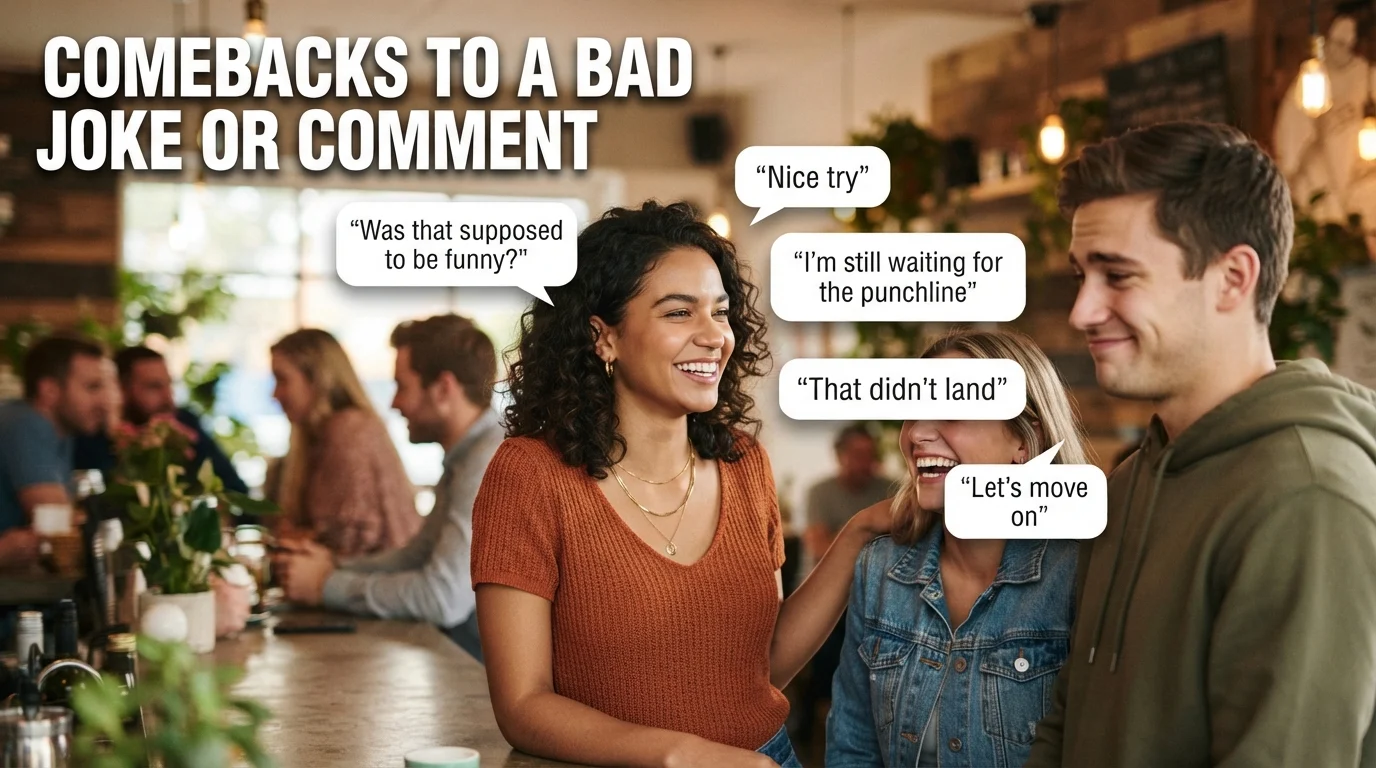
We’ve all been there: someone tells a joke that completely misses the mark, makes an awkward comment, or says something that deserves a quick response. You might want to laugh it off, call it out, or simply make the moment less uncomfortable. Having the right comeback can help you handle the situation without making things unnecessarily awkward.
The best comebacks to a bad joke or comment depend on the setting and your relationship with the person. A playful one-liner can work among friends, while a calm and direct response may be better at work or in a serious conversation. Here are funny, witty, sarcastic, clever, and classy responses you can use when someone’s comment falls flat.
1. “Was That Supposed to Be Funny?”
Sometimes a straightforward question says everything without needing a long explanation.
Best for: A joke that completely missed its intended effect.
Alternative: “I think the joke got lost somewhere.”
Examples:
“Was that supposed to be funny?”
“I feel like I missed the funny part.”
2. “Nice Try”
Keep your response short and playful when you don’t want to make the situation too serious.
Best for: Friends and casual conversations.
Alternative: “Points for effort.”
Examples:
“Nice try. Better luck next time.”
“I’ll give you points for effort.”
3. “That Joke Needed a Rewrite”
This comeback gently suggests that the joke wasn’t quite ready for an audience.
Best for: Someone who can take constructive teasing.
Alternative: “Maybe run that one by an editor first.”
Examples:
“That joke definitely needed a rewrite.”
“I think version two might work better.”
4. “I’ll Pretend I Didn’t Hear That”
Use this when you want to brush off an awkward or questionable comment.
Best for: Mildly inappropriate remarks.
Alternative: “Let’s pretend that never happened.”
Examples:
“I’ll pretend I didn’t hear that.”
“Okay, we’re just going to erase that moment.”
5. “That Was Painful”
A dramatic reaction can make a bad joke funny for the right reasons.
Best for: Playful situations with friends.
Alternative: “My secondhand embarrassment is thriving.”
Examples:
“That was painful to listen to.”
“Wow, I felt that one—and not in a good way.”
6. “Did You Practice That?”
Turn an awkward comment into a playful challenge.
Best for: Friends who regularly make jokes.
Alternative: “How long did you work on that one?”
Examples:
“Did you practice that before saying it?”
“How long did you prepare that masterpiece?”
7. “We’re Going to Need a Better One”
This comeback keeps the mood light while making it clear the joke failed.
Best for: Friendly banter.
Alternative: “Give it another shot.”
Examples:
“We’re going to need a better one than that.”
“Try again. I know you’ve got something better.”
8. “That Didn’t Land”
This is one of the simplest ways to describe a joke that received no reaction.
Best for: Casual conversations.
Alternative: “That one fell flat.”
Examples:
“Yeah, that didn’t land.”
“That joke just crash-landed.”
9. “I’m Still Waiting for the Punchline”
Use this when the joke feels incomplete.
Best for: Obvious attempts at humor that go nowhere.
Alternative: “Was there supposed to be a punchline?”
Examples:
“I’m still waiting for the punchline.”
“Let me know when we get to the funny part.”
10. “Bold of You to Say That”
A short sarcastic response can highlight how questionable the comment was.
Best for: Unexpected or awkward remarks.
Alternative: “That’s certainly a choice.”
Examples:
“Bold of you to say that out loud.”
“That’s a surprisingly confident thing to say.”
11. “Interesting Choice of Words”
This comeback is subtle and works especially well when someone says something questionable.
Best for: Comments that are awkward rather than openly offensive.
Alternative: “Interesting way to phrase that.”
Examples:
“Interesting choice of words.”
“That’s certainly one way to put it.”
12. “Let’s Not Do That Again”
Sometimes a clear boundary is better than sarcasm.
Best for: Repeated bad jokes or uncomfortable comments.
Alternative: “I’d rather we leave that joke alone.”
Examples:
“Let’s not do that again.”
“I think we can retire that joke.”
13. “That Wasn’t Your Best Work”
A playful critique can be surprisingly effective.
Best for: Friends who appreciate honest banter.
Alternative: “You’ve done better.”
Examples:
“That wasn’t your best work.”
“I’ve heard better from you.”
14. “Comedy Has Left the Chat”
This modern phrase works well in texting and online conversations.
Best for: Social media, group chats, and casual texting.
Alternative: “The comedy department has officially closed.”
Examples:
“Comedy has officially left the chat.”
“Someone call comedy support because that didn’t work.”
15. “I Think You Lost Me”
Use a softer response when you’re unsure whether the person was joking.
Best for: Ambiguous comments.
Alternative: “I’m not sure I understood the joke.”
Examples:
“I think you lost me with that one.”
“I’m not quite following the humor there.”
16. “Was That a Joke or a Cry for Help?”
This playful comeback works when someone delivers an especially terrible joke.
Best for: Close friends with a strong sense of humor.
Alternative: “Should I laugh or check on you?”
Examples:
“Was that a joke or a cry for help?”
“Do I laugh, or should I be concerned?”
17. “My Face Says It All”
Sometimes your reaction can be the comeback.
Best for: Situations where words aren’t necessary.
Alternative: “I think my expression answered that.”
Examples:
“My face has already reviewed that joke.”
“I don’t need to respond. My expression did it for me.”
18. “Let’s Move On”
Keep things mature when you don’t want to embarrass the other person.
Best for: Professional or sensitive situations.
Alternative: “Anyway, moving on.”
Examples:
“Let’s move on from that one.”
“Anyway, let’s talk about something else.”
19. “That’s a Tough Crowd, Even for Me”
Use self-aware humor to make the awkward moment less uncomfortable.
Best for: Group settings.
Alternative: “Even I don’t know how to respond to that.”
Examples:
“That’s a tough crowd, even for me.”
“You’ve officially left me speechless.”
20. “I’ll Give You Another Chance”
Turn the failed joke into a playful opportunity for a second attempt.
Best for: Lighthearted conversations.
Alternative: “You’ve got one more attempt.”
Examples:
“I’ll give you another chance.”
“Okay, reset. Try that one again.”
21. “That One Belongs in the Drafts”
This is a witty way to suggest that the comment should never have been delivered.
Best for: Texting and social media.
Alternative: “That should’ve stayed in your notes.”
Examples:
“That joke belongs in the drafts.”
“You probably should’ve left that one in your notes.”
22. “You Really Said That With Confidence”
The contrast between confidence and a bad comment creates the humor.
Best for: Bold but harmless comments.
Alternative: “I admire the confidence, at least.”
Examples:
“You really said that with confidence.”
“Honestly, I respect the confidence more than the joke.”
23. “I’m Going to Give That a Zero”
A mock rating can make a harmless bad joke into a funny moment.
Best for: Friends and playful banter.
Alternative: “Two out of ten for effort.”
Examples:
“I’m giving that one a zero.”
“Two out of ten. Please don’t retire your day job.”
24. “That Joke Needs a Warning Label”
Use exaggerated humor when a joke is spectacularly bad.
Best for: Close friends and casual settings.
Alternative: “That came with emotional damage.”
Examples:
“That joke needs a warning label.”
“Someone should’ve warned us before you told that one.”
25. “I’m Not Laughing, But I’m Impressed”
This comeback acknowledges the effort while still teasing the failed humor.
Best for: Friendly teasing.
Alternative: “Not funny, but definitely memorable.”
Examples:
“I’m not laughing, but I’m impressed by the confidence.”
“Not funny, but I’ll remember it.”
26. “Let’s Keep That Between You and Your Thoughts”
This response is sharper but still avoids a personal insult.
Best for: Comments that should not have been said aloud.
Alternative: “Some thoughts are better left unspoken.”
Examples:
“Let’s keep that one between you and your thoughts.”
“Some comments are better kept in the brain.”
27. “That Was Uncalled For”
When a comment crosses from bad humor into disrespect, be direct rather than trying to out-joke the person.
Best for: Hurtful, insulting, or inappropriate comments.
Alternative: “That wasn’t necessary.”
Examples:
“That was uncalled for.”
“That comment wasn’t necessary, and I’d rather you not repeat it.”
28. “Funny to You, Maybe”
This is useful when someone hides an insensitive comment behind “I was joking.”
Best for: Comments that genuinely bother you.
Alternative: “Calling it a joke doesn’t make it okay.”
Examples:
“Funny to you, maybe. It wasn’t funny to me.”
“If the joke hurts someone, it’s worth reconsidering.”
29. “You Can Do Better Than That”
A calm response can challenge someone without starting a bigger argument.
Best for: Friends, partners, or people you know well.
Alternative: “I expected better from you.”
Examples:
“You can definitely do better than that.”
“I know you’re capable of better jokes than that.”
30. “Anyway, Back to the Conversation”
Sometimes the smoothest comeback is refusing to give the bad comment more attention.
Best for: Group discussions, work, and mature conversations.
Alternative: “Anyway, where were we?”
Examples:
“Anyway, back to what we were talking about.”
“Let’s move on and get back to the actual conversation.”
How to Choose the Right Comeback
The best comeback depends on the context. A sarcastic one-liner may be hilarious with a close friend but inappropriate in a workplace or serious conversation. Think about your relationship with the speaker, the audience, and whether the comment was merely awkward or genuinely hurtful.
If the joke is harmless, humor can keep things relaxed. If someone makes a disrespectful remark, a direct boundary is usually more useful than trying to out-insult them. The goal is to respond confidently without creating unnecessary conflict.
Funny Comebacks vs. Classy Responses
Funny comebacks are designed to keep the interaction playful. They work especially well when everyone understands that the exchange is friendly banter.
Classy responses are different. They focus on composure and boundaries rather than getting the last laugh. When a comment is personal, offensive, or uncomfortable, a calm statement can communicate much more than sarcasm.
What If Someone Says “It Was Just a Joke”?
Not every joke deserves a laugh simply because the speaker calls it a joke. You can explain that something wasn’t funny to you without turning the situation into an argument.
Try saying, “I understand you were joking, but I didn’t appreciate the comment.” This keeps the focus on the behavior and how it affected the conversation.
How to Avoid Taking a Joke Too Far
A comeback should respond to the comment, not attack someone’s identity, appearance, background, or personal vulnerabilities. Once banter becomes genuinely hurtful, it stops being playful.
Keep your response focused on the joke itself. Clever teasing can be funny; personal humiliation usually creates unnecessary tension.
Why Timing Matters
Even a great comeback can fail if the timing is wrong. Saying something immediately may keep a playful moment moving, while waiting a few seconds can make a sarcastic response land better.
Read the room before responding. Consider whether people are laughing, uncomfortable, confused, or already upset.
FAQs
What is a good comeback to a bad joke?
A simple response such as “I think the joke got lost somewhere” or “I’m still waiting for the punchline” can work well. Choose something playful if the situation is friendly.
How do you respond to a rude comment disguised as a joke?
Be direct rather than escalating. You can say, “Funny to you, maybe, but that wasn’t okay with me,” or “I understand you were joking, but I didn’t appreciate that.”
What is a funny response to an unfunny joke?
Try “Comedy has left the chat,” “That one belongs in the drafts,” or “I’ll give you another chance.” These keep the tone humorous without becoming overly aggressive.
Should I use a savage comeback to a bad comment?
Only if the situation is clearly playful and the other person is comfortable with that style of banter. For genuinely hurtful comments, a calm boundary is usually more appropriate.
How can I shut down an inappropriate comment politely?
Keep it short and clear. Responses such as “That was uncalled for,” “Let’s not go there,” or “I’d rather you not make comments like that” can establish a boundary without creating more drama.
Conclusion
The best comebacks to a bad joke or comment don’t always have to be savage. Sometimes a funny one-liner makes everyone laugh, while other situations call for a calm, classy response that sets a clear boundary. Knowing the difference can help you handle awkward moments with confidence.
Before responding, consider the person’s intention, the setting, and how the comment made you feel. Whether you choose sarcasm, playful teasing, or a straightforward response, keep your comeback focused and respectful. The goal isn’t simply to win the exchange—it’s to handle the moment in a way you’ll feel good about afterward.

I am Alex James, the Administrator of Replieds. I help create useful, thoughtful, and engaging reply ideas that make conversations easier, more natural, confident, and meaningful for everyone.