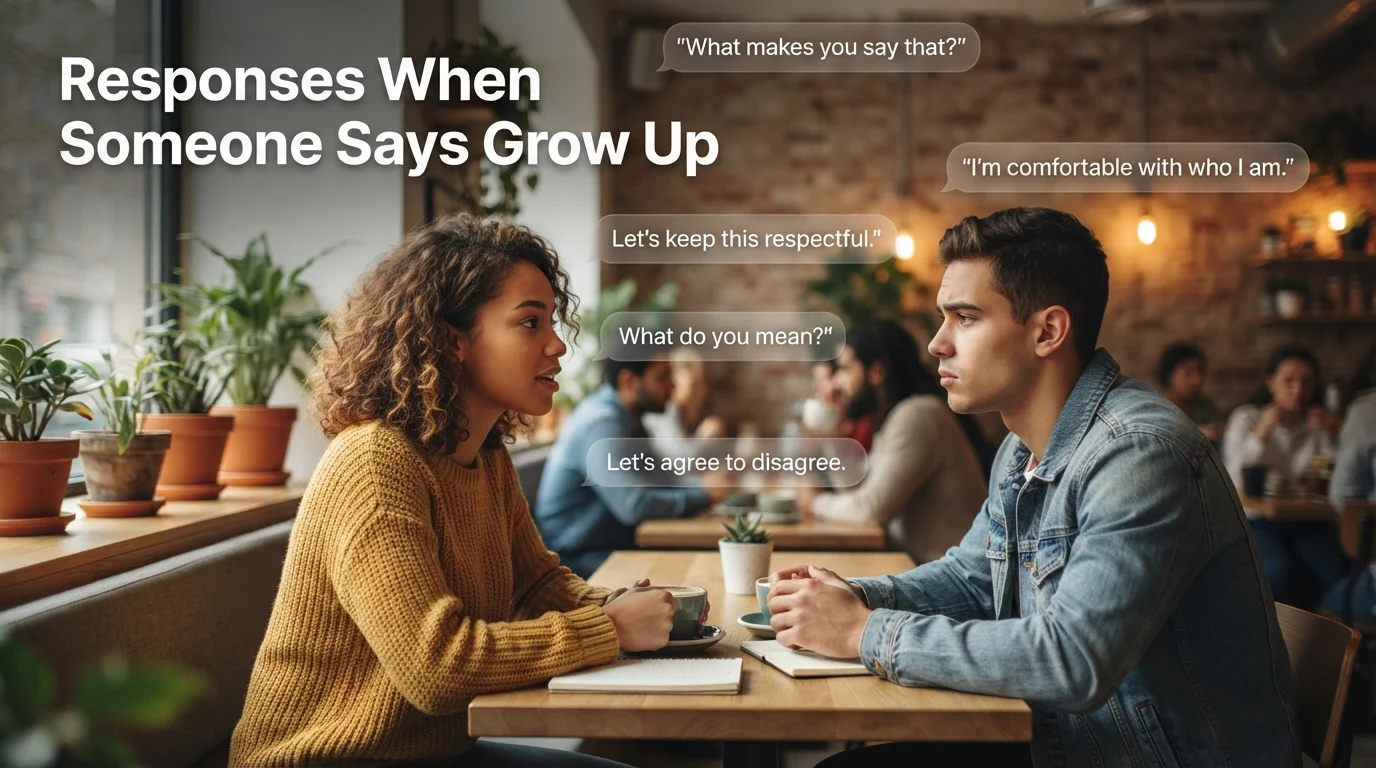
When someone says “grow up,” they may be criticizing your behavior, disagreeing with your attitude, or simply trying to shut down a conversation. The phrase can sound dismissive, especially when it is used without explaining what they think you did wrong. Knowing how to respond can help you stay confident without turning a small disagreement into a bigger argument.
The best responses when someone says grow up depend on the situation and your relationship with the person. You might want a calm reply, a funny comeback, a mature response, or a firm boundary. Instead of reacting emotionally, choose words that match the moment and communicate your point clearly.
1. “What Makes You Say That?”
This response calmly puts the focus back on the person making the criticism. It also gives them a chance to explain themselves.
Best for: When you genuinely want to understand their criticism.
Alternative: “What exactly did I do that seemed immature?”
Examples:
“What makes you think I need to grow up?”
“What did I do that came across as immature?”
2. “I’m Open to Feedback, but Be Specific.”
This response shows maturity while making it clear that vague criticism is not particularly helpful.
Best for: Serious conversations where you want constructive feedback.
Alternative: “I’ll listen if you tell me what the actual issue is.”
Examples:
“I’m open to feedback, but what specifically should I change?”
“If there’s a problem, tell me directly so I can understand it.”
3. “I’m Growing at My Own Pace.”
Not everyone has the same personality, priorities, or way of handling situations.
Best for: When someone is judging your personality or lifestyle.
Alternative: “I’m still learning, just like everyone else.”
Examples:
“I’m growing at my own pace, and I’m okay with that.”
“Everyone develops differently.”
4. “Being Serious All the Time Isn’t Maturity.”
This can be a thoughtful response when someone equates maturity with being serious.
Best for: Situations where someone criticizes you for joking or having fun.
Alternative: “Maturity doesn’t mean losing your sense of humor.”
Examples:
“I can be responsible and still enjoy myself.”
“Having fun doesn’t automatically make someone immature.”
5. “I Know When to Be Serious.”
This confident response shows that you understand the difference between appropriate and inappropriate behavior.
Best for: When someone mistakes your relaxed personality for immaturity.
Alternative: “I know how to handle serious situations.”
Examples:
“I know when it’s time to be serious.”
“Don’t confuse my sense of humor with irresponsibility.”
6. “Maybe We Just Have Different Ideas of Maturity.”
Maturity can look different from person to person, so this response avoids unnecessary confrontation.
Best for: Differences in personality or expectations.
Alternative: “We may simply see maturity differently.”
Examples:
“Maybe our definitions of maturity are different.”
“I think we just have different ideas about what being mature means.”
7. “I’ll Take That Under Consideration.”
This is a calm, slightly detached response that does not invite an argument.
Best for: When you do not want to debate.
Alternative: “Thanks for sharing your opinion.”
Examples:
“I’ll take that under consideration.”
“I hear you. I’ll think about it.”
8. “You’re Entitled to Your Opinion.”
Sometimes the simplest response is to acknowledge someone’s opinion without accepting it.
Best for: Unwanted criticism.
Alternative: “You’re free to see it that way.”
Examples:
“You’re entitled to your opinion, even if I disagree.”
“I understand that’s how you see it.”
9. “I’d Rather Talk About the Actual Issue.”
This shifts the conversation away from personal attacks and toward the real disagreement.
Best for: Arguments where “grow up” is being used as an insult.
Alternative: “Let’s discuss the problem instead of labeling each other.”
Examples:
“Let’s talk about what actually happened.”
“If there’s an issue, I’d rather address it directly.”
10. “What Would Growing Up Look Like to You?”
This turns a vague statement into a specific question.
Best for: When someone repeatedly tells you to grow up.
Alternative: “What exactly are you expecting me to do differently?”
Examples:
“What would growing up look like in this situation?”
“What behavior would you consider more mature?”
11. “I’m Allowed to Have a Personality.”
A person can be responsible without changing everything about their personality.
Best for: When someone dislikes your humor, energy, or personality.
Alternative: “Being myself doesn’t mean I’m immature.”
Examples:
“I can be responsible without becoming someone else.”
“My personality isn’t a maturity test.”
12. “Maturity Means Knowing When to Walk Away.”
Sometimes refusing to argue is the most mature option.
Best for: Heated conversations.
Alternative: “I don’t need to argue about this.”
Examples:
“I think walking away is more mature than arguing.”
“I’m not going to turn this into a bigger fight.”
13. “I’m Working on Myself, Like Everyone Else.”
This response acknowledges personal growth without accepting an unfair judgment.
Best for: Honest and reflective conversations.
Alternative: “I’m still learning and improving.”
Examples:
“I’m working on myself every day.”
“I have things to improve, just like everyone else.”
14. “You Can Explain Without Insulting Me.”
This sets a respectful communication boundary.
Best for: When “grow up” feels deliberately insulting.
Alternative: “You can make your point without talking down to me.”
Examples:
“If you disagree with me, explain why without insulting me.”
“You can tell me what bothered you without putting me down.”
15. “I Understand Your Point.”
Sometimes acknowledging what someone says can immediately lower the tension.
Best for: Situations where you want to de-escalate.
Alternative: “I hear what you’re saying.”
Examples:
“I understand your point. I’ll think about it.”
“I hear you, even though I may see things differently.”
16. “Maybe, but I’m Still Having Fun.”
This playful response works when the criticism is lighthearted.
Best for: Friends and casual conversations.
Alternative: “Maybe I’m mature enough to enjoy myself.”
Examples:
“Maybe, but I’m having a good time.”
“I’ll grow up eventually—today isn’t the day.”
17. “Don’t Worry, I’m Getting There.”
This turns the criticism into a light joke.
Best for: Friendly teasing.
Alternative: “Give me a little time.”
Examples:
“Don’t worry, I’m getting there.”
“I’m still loading the maturity update.”
18. “I’m Not Taking Life Advice From This Conversation.”
This is firmer and works when the other person is being unnecessarily condescending.
Best for: Repeated or disrespectful criticism.
Alternative: “I don’t think this conversation is productive.”
Examples:
“I’m not looking for life advice right now.”
“Let’s leave the personal criticism out of this.”
19. “Funny, I Was Thinking the Same About Your Comment.”
This is a witty comeback that points out the irony without becoming overly aggressive.
Best for: Playful arguments or verbal sparring.
Alternative: “Interesting advice, considering how this conversation is going.”
Examples:
“Funny, I was thinking the same thing about that comment.”
“That’s an interesting lesson to give while talking like that.”
20. “I’ll Decide What Growing Up Means for Me.”
This confidently establishes personal autonomy.
Best for: Someone trying to dictate your personality or choices.
Alternative: “I know myself better than you do.”
Examples:
“I’ll decide what personal growth looks like for me.”
“I appreciate the concern, but I know what I’m working toward.”
21. “If You Have a Point, Just Say It.”
This response discourages vague insults and encourages direct communication.
Best for: Arguments and disagreements.
Alternative: “What are you actually trying to tell me?”
Examples:
“If you have a point, just tell me directly.”
“Skip the label and tell me what the problem is.”
22. “Let’s Keep This Respectful.”
This is short, mature, and effective when the conversation starts becoming disrespectful.
Best for: Workplace, family, and serious conversations.
Alternative: “We can disagree without disrespecting each other.”
Examples:
“Let’s keep this conversation respectful.”
“We can talk about the issue without attacking each other.”
23. “I Don’t Think a Personal Attack Helps.”
This calmly identifies the problem with the phrase itself.
Best for: Difficult disagreements.
Alternative: “Personal comments aren’t helping us solve this.”
Examples:
“I don’t think calling me immature solves anything.”
“Let’s focus on the issue instead of making it personal.”
24. “Maybe You’re Right About One Thing.”
A little humor can take the sting out of the comment.
Best for: Lighthearted situations.
Alternative: “I probably still have some growing to do.”
Examples:
“Maybe you’re right—I still have plenty to learn.”
“We all have room to grow.”
25. “I’m Comfortable With Who I Am.”
This response communicates confidence without attacking the other person.
Best for: Personal criticism.
Alternative: “I’m not interested in changing just to satisfy someone else.”
Examples:
“I’m comfortable with who I am.”
“I know I have flaws, and I’m still comfortable being myself.”
26. “That’s Your Perspective.”
This is a neutral way to acknowledge disagreement.
Best for: Conversations that are becoming repetitive.
Alternative: “That’s how you see it.”
Examples:
“That’s your perspective, and I respect that.”
“I see it differently, but I understand your perspective.”
27. “I’m Listening, So Tell Me What I’m Missing.”
This is particularly effective when you want to turn criticism into useful communication.
Best for: Constructive conversations.
Alternative: “Tell me what you think I’m doing wrong.”
Examples:
“I’m listening. What am I missing?”
“If you think I handled it badly, explain why.”
28. “I Don’t Need to Prove My Maturity to You.”
This establishes a clear personal boundary.
Best for: Someone repeatedly judging your behavior.
Alternative: “I’m not going to defend my personality.”
Examples:
“I don’t need to prove how mature I am.”
“My choices don’t need your approval.”
29. “Let’s Agree to Disagree.”
When neither person is changing their mind, continuing the argument may not accomplish anything.
Best for: Repeated disagreements.
Alternative: “We clearly see this differently.”
Examples:
“Let’s agree to disagree and move on.”
“We don’t have to agree on everything.”
30. “Maybe Growing Up Means Knowing When Not to Argue.”
This is a clever response that turns the idea of maturity back toward peaceful communication.
Best for: A calm but confident comeback.
Alternative: “Sometimes maturity is choosing peace over an argument.”
Examples:
“Maybe growing up means knowing which arguments aren’t worth having.”
“I think maturity is also knowing when to let something go.”
FAQs
What is a good response when someone says “grow up”?
A good response depends on the situation. You can say, “What makes you say that?”, “If there’s an issue, tell me directly,” or “Let’s keep this respectful.”
What is a funny response to “grow up”?
For a lighthearted situation, try “I’m still waiting for the update,” “Give me a minute,” or “Maybe tomorrow.” Keep humor appropriate to the relationship.
How do you respond to “grow up” without being rude?
Stay calm and ask for specifics. Phrases such as “What exactly do you mean?” or “Could you explain what you think I should change?” keep the conversation constructive.
What does “grow up” usually mean in an argument?
It often means the speaker thinks someone’s behavior is immature, irresponsible, overly emotional, or inappropriate. However, the phrase is vague, so asking for specific examples can prevent misunderstanding.
Is ignoring someone who says “grow up” a mature response?
Sometimes. If the comment is clearly intended to provoke you and there is no productive conversation to have, disengaging can be more useful than escalating the argument.
Conclusion
The best responses when someone says grow up are not necessarily the harshest comebacks. A thoughtful response can help you understand what the person means, defend your boundaries, or simply end an unproductive argument. Whether you choose a calm question, a confident statement, or a little humor, match your response to the situation.
Remember that maturity is not about always being serious or never making mistakes. It can also mean communicating respectfully, accepting useful feedback, recognizing when you are wrong, and knowing when an argument is not worth continuing. Choose a response that keeps your dignity while moving the conversation in a healthier direction.

I am Alex James, the Administrator of Replieds. I help create useful, thoughtful, and engaging reply ideas that make conversations easier, more natural, confident, and meaningful for everyone.