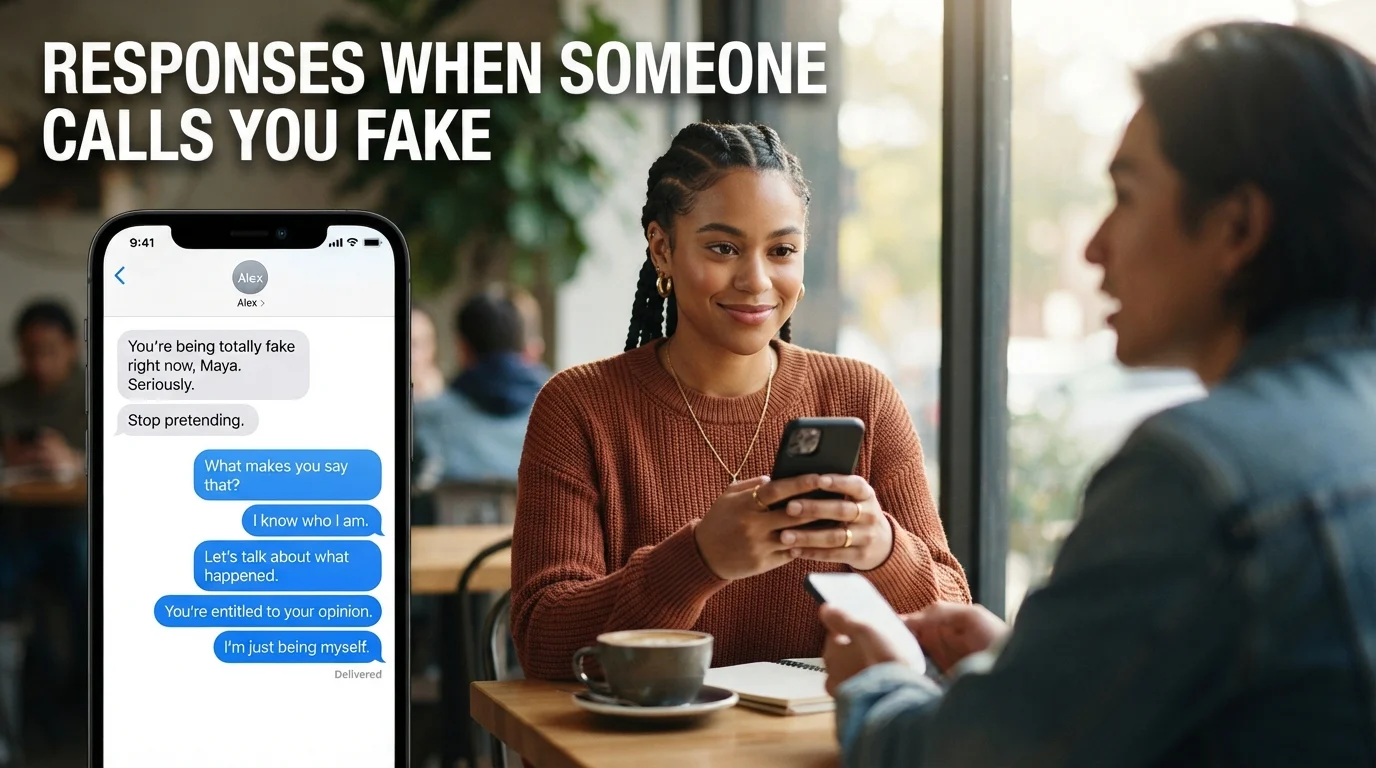
Being called “fake” can feel unfair, especially when you believe you have been genuine with someone. Whether the comment comes from a friend, coworker, family member, stranger, or someone online, your response can shape the entire conversation. A thoughtful reply can defend your character without turning a small disagreement into a bigger argument.
The best responses when someone calls you fake depend on the situation and your relationship with that person. You might want a calm response that asks for clarification, a confident comeback that sets a boundary, or a funny reply that keeps things light. The goal is not always to prove someone wrong; sometimes, it is simply to communicate your side clearly and move forward.
1. “What Makes You Say That?”
Instead of immediately becoming defensive, ask the person to explain their accusation. This puts the focus on the specific behavior they are criticizing.
Best for: Calm conversations where you genuinely want to understand the issue.
Alternative: “What did I do that made you feel that way?”
Examples:
- “What makes you say that? I’d like to understand.”
- “What exactly did I do that seemed fake to you?”
2. “I’m Just Being Myself.”
This simple response confidently reinforces that you are comfortable with who you are. You do not need to overexplain yourself.
Best for: Situations where someone misunderstands your personality.
Alternative: “This is genuinely who I am.”
Examples:
- “I’m just being myself. You don’t have to like it.”
- “I’m comfortable being myself, even if we see things differently.”
3. “You’re Entitled to Your Opinion.”
Sometimes the most mature response is to acknowledge someone’s opinion without accepting it as fact.
Best for: Arguments that are not worth continuing.
Alternative: “That’s your opinion, and I respect that.”
Examples:
- “You’re entitled to your opinion, but I know myself.”
- “You can see me that way, but I don’t agree.”
4. “If I’m Fake, What Did I Pretend to Be?”
This clever response asks the other person to provide something concrete instead of making a vague accusation.
Best for: Confident conversations where you want clarification.
Alternative: “What exactly have I pretended to be?”
Examples:
- “If I’m fake, what exactly am I pretending to be?”
- “What part of me do you think isn’t genuine?”
5. “You Don’t Have to Understand Me.”
Not everyone will understand your personality, choices, or boundaries. This response makes it clear that you are not seeking everyone’s approval.
Best for: Dealing with unnecessary criticism.
Alternative: “You don’t have to agree with me.”
Examples:
- “You don’t have to understand me for me to be comfortable with myself.”
- “It’s okay if you don’t get me.”
6. “I’d Rather Be Honest Than Popular.”
This confident response emphasizes authenticity over trying to please everyone.
Best for: Someone accusing you of changing your behavior to impress people.
Alternative: “I’m not here to impress everyone.”
Examples:
- “I’d rather be honest than pretend to fit in.”
- “Being myself matters more to me than being liked.”
7. “Maybe We See Authenticity Differently.”
People sometimes have different expectations about what being genuine looks like. This response keeps the conversation respectful.
Best for: Mature disagreements.
Alternative: “Maybe we have different ideas about being genuine.”
Examples:
- “Maybe we simply have different ideas about what being real means.”
- “We may see authenticity differently, and that’s okay.”
8. “I’m Open to Hearing Why You Feel That Way.”
If you actually care about the relationship, showing willingness to listen can prevent the disagreement from escalating.
Best for: Friends, partners, or family members.
Alternative: “Tell me what made you feel that way.”
Examples:
- “I’m open to hearing your side. What happened?”
- “If I did something that hurt you, I’m willing to listen.”
9. “Calling Me Fake Doesn’t Make It True.”
This is a direct but controlled response. It separates someone’s accusation from objective reality.
Best for: Unfair or unsupported accusations.
Alternative: “An accusation isn’t automatically a fact.”
Examples:
- “Calling me fake doesn’t make me fake.”
- “You can make that claim, but that doesn’t make it true.”
10. “I Know My Intentions.”
Sometimes other people interpret your actions differently from how you intended them. This response reminds them that you understand your own motivations.
Best for: Misunderstandings.
Alternative: “I know where I was coming from.”
Examples:
- “I know my intentions, and I wasn’t trying to be fake.”
- “You may have interpreted it differently, but I know what I meant.”
11. “If I Hurt You, Tell Me Directly.”
Rather than arguing about labels, this response invites a productive conversation about actual behavior.
Best for: Personal relationships.
Alternative: “Tell me what I did instead of labeling me.”
Examples:
- “If something I did hurt you, please tell me directly.”
- “I’d rather discuss what happened than call each other names.”
12. “I Don’t Need to Prove Who I Am.”
You are not required to convince everyone of your character. Sometimes stepping away from the debate is healthier.
Best for: Repeated accusations and pointless arguments.
Alternative: “I know who I am.”
Examples:
- “I don’t need to prove my character to everyone.”
- “I know who I am, and I’m at peace with that.”
13. “That’s Not How I See Myself.”
This response acknowledges the person’s perspective without agreeing with it.
Best for: Calm disagreements.
Alternative: “That description doesn’t reflect how I see myself.”
Examples:
- “That’s not how I see myself at all.”
- “I understand that’s your impression, but it doesn’t describe me.”
14. “Maybe You’re Judging Me Too Quickly.”
Sometimes people form conclusions from limited information. This response gently challenges that assumption.
Best for: New acquaintances or misunderstandings.
Alternative: “You may not know the whole story.”
Examples:
- “Maybe you’re judging me based on one situation.”
- “You might be seeing one side without knowing the full context.”
15. “I Can Accept Criticism, but Be Specific.”
Constructive criticism is easier to address than vague name-calling. Ask for details if you genuinely want feedback.
Best for: Work, friendships, and serious conversations.
Alternative: “If you have an issue with me, tell me specifically.”
Examples:
- “I can accept criticism, but I need you to be specific.”
- “Tell me what behavior bothered you instead of calling me fake.”
16. “You Don’t Know Everything About Me.”
Someone’s opinion may be based on only a small part of your personality or behavior.
Best for: People who make assumptions about you.
Alternative: “You only know part of my story.”
Examples:
- “You don’t know everything about me, so I wouldn’t judge too quickly.”
- “You’ve seen one side of me, not my whole story.”
17. “I’m Not Going to Argue About My Character.”
This is a firm boundary that prevents the conversation from turning into an endless argument.
Best for: Heated situations.
Alternative: “I’m not interested in arguing about this.”
Examples:
- “I’m not going to argue about who I am.”
- “If we can talk respectfully, I’m willing to listen.”
18. “Believe What You Want.”
Sometimes you reach a point where further explanation will not change someone’s mind. This response communicates emotional distance.
Best for: Situations where you want to end the discussion.
Alternative: “You’re free to think that.”
Examples:
- “Believe what you want. I know the truth about myself.”
- “You can believe that if you want, but I’m not going to argue.”
19. “I’m Not Perfect, but I’m Not Fake.”
This response accepts that you have flaws without accepting an unfair label.
Best for: Honest, mature conversations.
Alternative: “I have flaws, but I’m genuine.”
Examples:
- “I’m not perfect, but everything about me isn’t an act.”
- “I make mistakes, but that doesn’t mean I’m pretending.”
20. “If You Have a Problem, Talk to Me About It.”
Direct communication can be much more productive than accusations.
Best for: Friends, coworkers, and relationship disagreements.
Alternative: “Let’s talk about what’s actually bothering you.”
Examples:
- “If you have a problem with me, I’d rather you tell me directly.”
- “Let’s talk about what happened instead of throwing labels around.”
21. “That’s an Interesting Assumption.”
This lightly challenges the accusation without immediately starting a fight.
Best for: Calm or slightly sarcastic situations.
Alternative: “That’s quite an assumption.”
Examples:
- “That’s an interesting assumption. What brought you to that conclusion?”
- “Interesting. I’m curious what made you think that.”
22. “I’m Not Responsible for Your Interpretation.”
People can interpret the same behavior differently. This response draws a boundary around assumptions.
Best for: Misunderstandings and online arguments.
Alternative: “I can explain my actions, but I can’t control your interpretation.”
Examples:
- “I can explain what I meant, but I can’t control how you interpret it.”
- “Your interpretation is yours; my intentions were different.”
23. “Maybe We Should Take a Step Back.”
When emotions are running high, taking a break can prevent the disagreement from getting worse.
Best for: Heated conversations.
Alternative: “Let’s talk about this when we’re both calmer.”
Examples:
- “Maybe we should take a step back and talk later.”
- “I don’t want this to turn into an argument, so let’s pause.”
24. “I’d Rather Show You Than Argue.”
Actions over time often communicate more than one defensive conversation.
Best for: Relationships where trust matters.
Alternative: “My actions can speak for themselves.”
Examples:
- “I’d rather show you who I am than argue about it.”
- “Give it time. My actions will tell you more than words.”
25. “You’re Allowed to Feel That Way.”
This response acknowledges someone’s feelings without admitting that their accusation is correct.
Best for: Emotionally charged conversations.
Alternative: “I understand that’s how you feel.”
Examples:
- “You’re allowed to feel that way, even though I see it differently.”
- “I hear you, but I don’t agree with that description of me.”
26. “What Would Being Genuine Look Like to You?”
This question can uncover the real issue behind the accusation. Perhaps the person expects different communication or behavior.
Best for: Relationships where you want honest feedback.
Alternative: “What would make you feel that I’m being genuine?”
Examples:
- “What would genuine behavior look like to you?”
- “What would you have wanted me to do differently?”
27. “I’m Comfortable With Who I Am.”
Confidence can be a better response than defensiveness. You do not have to let someone else’s label define you.
Best for: Personal confidence and casual criticism.
Alternative: “I’m secure in who I am.”
Examples:
- “I’m comfortable with who I am, even if you disagree.”
- “I know myself well enough not to let one comment define me.”
28. “Let’s Focus on What Actually Happened.”
This response redirects the conversation from personal attacks to specific facts.
Best for: Serious disagreements.
Alternative: “Let’s discuss the situation instead of labeling each other.”
Examples:
- “Let’s focus on what actually happened and clear it up.”
- “We can talk about my actions without making it personal.”
29. “I’m Not Going to Chase Your Approval.”
If someone repeatedly questions your authenticity, you do not have to spend endless energy trying to convince them.
Best for: Situations involving repeated criticism.
Alternative: “I don’t need everyone to approve of me.”
Examples:
- “I’m not going to chase your approval to prove I’m genuine.”
- “You don’t have to like me, and I don’t have to convince you.”
30. “You Can Think That, I’ll Keep Being Me.”
This confident closing response shows that you are not interested in changing yourself simply because someone has criticized you.
Best for: Ending a conversation with confidence.
Alternative: “You can have your opinion; I’ll stay true to myself.”
Examples:
- “You can think that. I’m still going to be myself.”
- “That’s your opinion, and I’ll continue being genuine.”
How to Choose the Right Response When Someone Calls You Fake
The right reply depends on whether the person is joking, genuinely hurt, misunderstanding you, or deliberately trying to provoke you. A close friend deserves a different response from an anonymous person online.
If you value the relationship, ask what caused the feeling rather than immediately using a comeback. If the accusation is simply meant to provoke you, a short boundary-setting response may be more useful than a long explanation.
Funny Responses When Someone Calls You Fake
A little humor can take the tension out of the situation when the accusation is clearly playful. Keep the joke light rather than using humor to embarrass the other person.
You might say, “Wow, my acting career is finally taking off,” or “At least tell me I’m a convincing fake.” These work best when both people understand that the conversation is playful.
Classy Responses When Someone Calls You Fake
A classy response usually avoids insults and focuses on confidence. You can disagree without attacking the other person’s character.
Try phrases such as “I respect your opinion, but I don’t agree,” or “I’d rather discuss what I actually did than use labels.” These responses keep the conversation mature.
When Someone Calls You Fake Online
Online conversations can escalate quickly because tone is difficult to read. Before responding, consider whether the person is actually interested in a discussion.
A simple “What makes you think that?” can work better than a long paragraph. If someone continues provoking you, you may not need to engage at all.
What Not to Say When Someone Calls You Fake
Avoid immediately responding with personal insults, threats, or accusations of your own. Those responses may turn a disagreement into a larger conflict.
Instead, focus on specific behavior, ask questions, or end the conversation respectfully. You can defend yourself without becoming unnecessarily hostile.
FAQs
1. What is the best response when someone calls you fake?
A calm response such as “What makes you say that?” can be useful because it asks the person to explain their accusation rather than turning the situation into an argument.
2. How do you respond when someone calls you fake in a rude way?
You can stay firm and say, “If you have an issue with something I did, tell me specifically.” This addresses the behavior without returning the insult.
3. What is a classy response to being called fake?
Try, “You’re entitled to your opinion, but I know who I am.” It communicates confidence without attacking the other person.
4. Should you defend yourself when someone calls you fake?
It depends on the situation. If the relationship matters, asking what caused the accusation can lead to a useful conversation. If the person is simply provoking you, disengaging may be more productive.
5. How can you respond without starting an argument?
Keep your response short, calm, and focused on the issue. “I don’t agree with that, but I’m willing to discuss what happened” is a good example.
Conclusion
Knowing different responses when someone calls you fake can help you handle criticism without immediately becoming defensive. You can ask for clarification, explain your intentions, set a boundary, use gentle humor, or simply choose not to engage.
The strongest response is often the one that fits the situation. If someone genuinely feels hurt, listen and discuss the specific behavior. If they are making an unsupported accusation, calmly stand up for yourself. And if the conversation becomes disrespectful, remember that you are allowed to step away.
Being confident does not require winning every argument. Sometimes, staying calm, communicating clearly, and remaining true to yourself says more than any comeback ever could.

I am Alex James, the Administrator of Replieds. I help create useful, thoughtful, and engaging reply ideas that make conversations easier, more natural, confident, and meaningful for everyone.