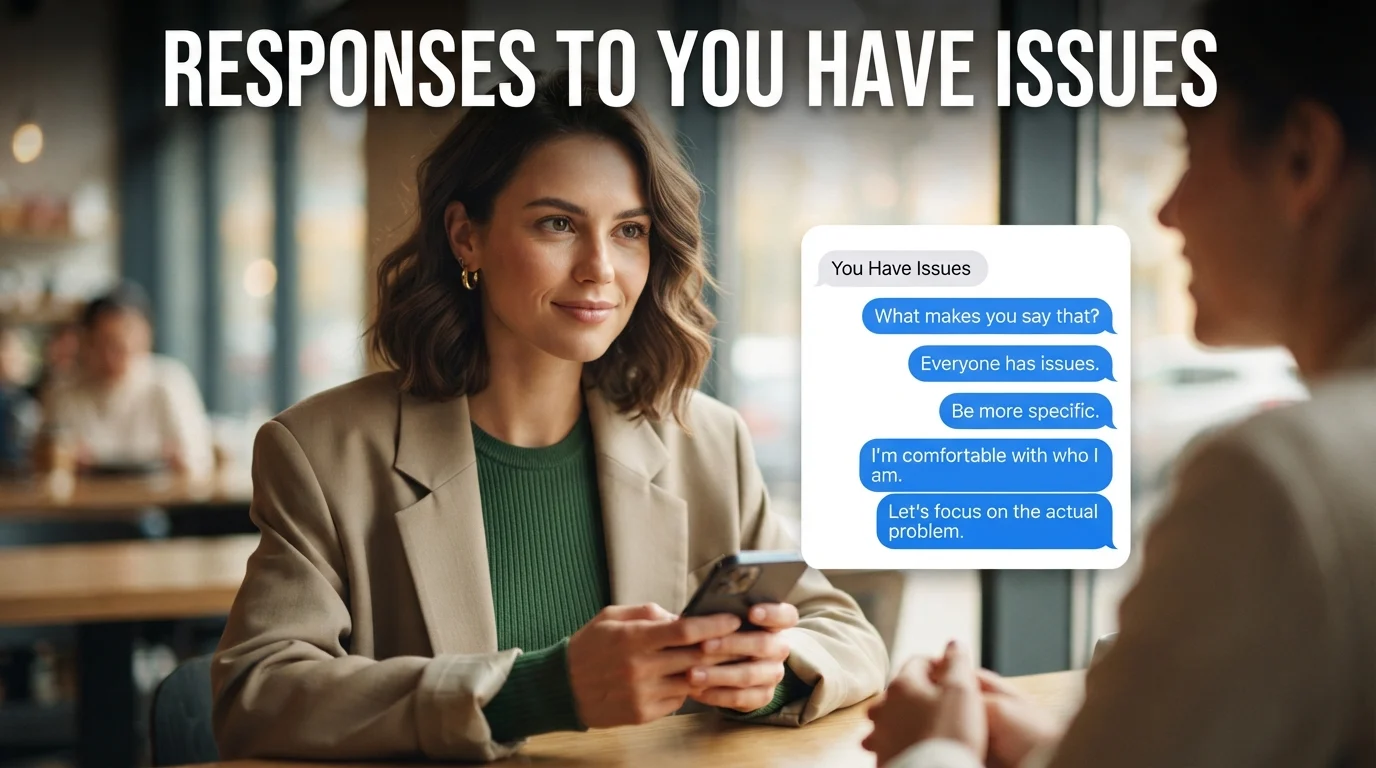
When someone says “You have issues,” it can feel dismissive, rude, or even confusing. Sometimes they may be joking, while other times they are genuinely criticizing your behavior. The best response depends on the tone, your relationship with the person, and whether there is actually something worth discussing.
Having a few thoughtful responses to “you have issues” can help you stay confident without making the situation worse. You can respond with humor, ask what they mean, set a boundary, or simply brush off the comment. The key is choosing a reply that matches the situation instead of reacting impulsively.
1. “What Makes You Say That?”
This is a calm way to find out what the person actually means. Instead of arguing over a vague statement, ask them to explain it.
Best for: Genuine conversations and misunderstandings.
Alternative: “What makes you think I have issues?”
Examples:
- “What makes you say that?”
- “I’m curious—what did I do that made you think that?”
2. “Everyone Has Issues.”
This response puts the comment into perspective without becoming overly defensive.
Best for: Casual conversations and light criticism.
Alternative: “Nobody is perfect.”
Examples:
- “Everyone has issues. I’m just honest about mine.”
- “We all have things to work on.”
3. “At Least I’m Interesting.”
Turn the criticism into a playful compliment about yourself. This works especially well when the other person is teasing.
Best for: Friends and playful situations.
Alternative: “Boring was never really my thing.”
Examples:
- “At least I’m interesting.”
- “I prefer ‘complicated and fascinating.’”
4. “You’ll Have to Be More Specific.”
This confident response asks the person to explain their accusation rather than leaving it as a vague insult.
Best for: Serious disagreements.
Alternative: “Which issue are we talking about?”
Examples:
- “You’ll have to be more specific.”
- “Okay, which particular issue are you referring to?”
5. “And You’re Just Noticing?”
This playful comeback suggests that your personality is hardly a secret.
Best for: Close friends and joking situations.
Alternative: “Took you long enough to notice.”
Examples:
- “And you’re just noticing?”
- “Wow, I thought that was obvious.”
6. “I Prefer ‘Work in Progress.’”
This turns a potentially negative comment into something constructive.
Best for: Lighthearted conversations.
Alternative: “I’m still under construction.”
Examples:
- “I prefer ‘work in progress.’”
- “I’m a work in progress, just like everyone else.”
7. “Maybe, But I’m Working on Myself.”
This is a mature answer that acknowledges imperfection without allowing someone else to define you.
Best for: Honest conversations.
Alternative: “I know I have things to improve.”
Examples:
- “Maybe I do, but I’m working on myself.”
- “I’m aware I have things to work on, and I’m trying.”
8. “What Issues Are You Talking About?”
Sometimes the person may actually have a specific concern. Asking directly can turn an insult into a useful conversation.
Best for: Friends, partners, and family.
Alternative: “What exactly is bothering you?”
Examples:
- “What issues are you talking about?”
- “Can you tell me what behavior you’re referring to?”
9. “That’s Quite an Observation.”
This understated response can be slightly sarcastic without becoming openly hostile.
Best for: Someone making an unnecessary comment.
Alternative: “Interesting observation.”
Examples:
- “That’s quite an observation.”
- “Interesting. I’ll add that to today’s feedback.”
10. “I’m Not Perfect, and That’s Okay.”
Nobody has to be flawless. This response shows self-awareness without accepting an insult as a complete description of you.
Best for: Personal criticism.
Alternative: “I have flaws, just like everyone else.”
Examples:
- “I’m not perfect, and I’m okay with that.”
- “I have flaws, but that doesn’t define everything about me.”
11. “If You’re Concerned, Talk to Me About It.”
This response encourages direct communication rather than vague criticism.
Best for: Relationships and meaningful conversations.
Alternative: “If something is bothering you, tell me directly.”
Examples:
- “If you’re concerned about me, we can talk about it.”
- “If there’s something specific bothering you, tell me.”
12. “That’s Your Opinion.”
Sometimes you do not need to debate someone else’s judgment.
Best for: Unproductive arguments.
Alternative: “You’re entitled to your opinion.”
Examples:
- “That’s your opinion, and I see it differently.”
- “You’re allowed to think that.”
13. “I’ll Take That Under Advisement.”
This is a clever, slightly formal way to acknowledge the comment without giving it too much importance.
Best for: Sarcastic or playful situations.
Alternative: “Thanks for the feedback.”
Examples:
- “I’ll take that under advisement.”
- “Thanks for the unsolicited assessment.”
14. “At Least I’m Self-Aware.”
This turns the criticism into a confident statement.
Best for: Playful conversations.
Alternative: “At least I know myself.”
Examples:
- “At least I’m self-aware.”
- “I know myself pretty well, actually.”
15. “We All Have Our Quirks.”
Not every unusual habit is an actual problem. This response keeps the conversation light.
Best for: Friends and casual teasing.
Alternative: “I just have personality.”
Examples:
- “We all have our quirks.”
- “I call them personality traits.”
16. “You Don’t Have to Agree With Me.”
This establishes that differences in personality or opinions are normal.
Best for: Arguments about behavior or personality.
Alternative: “We can simply see things differently.”
Examples:
- “You don’t have to agree with me.”
- “It’s okay if my way isn’t your way.”
17. “Maybe You Should Explain.”
If someone makes a serious accusation, asking them to explain can reveal whether there is any substance behind it.
Best for: Serious conversations.
Alternative: “Can you explain what you mean?”
Examples:
- “Maybe you should explain what you mean by that.”
- “What specifically makes you think I have issues?”
18. “I’m Comfortable With Who I Am.”
Confidence can be a strong answer to personal criticism.
Best for: Dealing with judgmental comments.
Alternative: “I know who I am.”
Examples:
- “I’m comfortable with who I am.”
- “I know myself, and I’m not going to let one comment define me.”
19. “That’s Not Exactly Helpful.”
This is a polite way to tell someone their comment is not contributing to the conversation.
Best for: Workplace or serious situations.
Alternative: “If you want to help, be specific.”
Examples:
- “That comment isn’t exactly helpful.”
- “If you have constructive feedback, I’m willing to hear it.”
20. “Let’s Focus on the Actual Problem.”
If there is a disagreement, personal labels rarely solve it. Redirect the discussion toward the real issue.
Best for: Arguments and conflicts.
Alternative: “Let’s talk about what actually happened.”
Examples:
- “Let’s focus on the actual problem instead of labeling me.”
- “What happened is more important than calling me names.”
21. “Maybe I Do, Maybe I Don’t.”
This deliberately vague answer can be playful and disarming.
Best for: Light teasing.
Alternative: “That’s classified information.”
Examples:
- “Maybe I do. Maybe I don’t.”
- “I could tell you, but then I’d have to charge you.”
22. “And Yet, Here You Are.”
This cheeky response works when someone keeps commenting on you despite supposedly disliking your personality.
Best for: Playful banter.
Alternative: “Still keeping tabs on me, though.”
Examples:
- “And yet, here you are talking about me.”
- “Funny how interested you are in my issues.”
23. “I’m Sure You Have Your Reasons.”
This response remains calm while acknowledging that the person has formed an opinion.
Best for: Situations where you don’t want an argument.
Alternative: “I’m sure that’s how you see it.”
Examples:
- “I’m sure you have your reasons for saying that.”
- “I understand that’s your perspective.”
24. “I’d Rather Hear Something Specific.”
Vague insults do not provide useful feedback. Asking for specifics makes the conversation more productive.
Best for: Mature disagreements.
Alternative: “Tell me what specifically bothers you.”
Examples:
- “I’d rather hear something specific than a general label.”
- “If there’s a problem, tell me exactly what it is.”
25. “Thanks for the Diagnosis.”
This is a humorous comeback when someone is pretending to analyze your personality.
Best for: Sarcastic or playful conversations.
Alternative: “Should I send you my consultation fee?”
Examples:
- “Thanks for the diagnosis.”
- “Wow, and you did all that analysis for free?”
26. “I’ll Survive.”
This short response shows that you are not overly affected by the criticism.
Best for: Casual comments and teasing.
Alternative: “I think I’ll be okay.”
Examples:
- “I’ll survive.”
- “Don’t worry, I’ll make it through.”
27. “Maybe We Should Agree to Disagree.”
Not every conversation needs a winner. Sometimes ending the debate is the most productive choice.
Best for: Repeated disagreements.
Alternative: “We clearly see this differently.”
Examples:
- “Maybe we should agree to disagree.”
- “We don’t see this the same way, and that’s okay.”
28. “If You Mean Something Serious, Say It Clearly.”
This firm response encourages respectful communication.
Best for: Hurtful or vague comments.
Alternative: “If there’s a real concern, tell me directly.”
Examples:
- “If you mean something serious, say it clearly.”
- “I’m willing to listen if you want to have a real conversation.”
29. “I’m Not Going to Argue About Myself.”
You do not have to defend your entire personality every time someone makes a negative comment.
Best for: Arguments that are becoming repetitive.
Alternative: “I don’t need to prove myself to you.”
Examples:
- “I’m not going to argue about who I am.”
- “I know myself well enough not to debate this.”
30. “Call It What You Want—I’m Still Me.”
This confident closing line communicates self-acceptance without attacking the other person.
Best for: Ending a conversation confidently.
Alternative: “You can have your opinion; I’ll stay true to myself.”
Examples:
- “Call it what you want. I’m still me.”
- “You can have your opinion, but I’m comfortable being myself.”
How to Choose the Right Response to “You Have Issues”
The best response depends on the intention behind the comment. If someone is joking, a funny comeback may keep things friendly. If they are genuinely concerned, asking what they mean can lead to a useful conversation.
If the statement is meant to insult you, you do not need to match their negativity. A short response such as “What makes you say that?” can shift the conversation from personal attacks toward something specific.
Funny Responses to “You Have Issues”
Humor can be useful when you know the person is teasing rather than genuinely attacking you. A playful answer can keep the interaction from becoming unnecessarily serious.
Try “I prefer ‘limited edition,’” “At least I keep things interesting,” or “We all need a little character development.” Keep the humor friendly and avoid jokes that could make the disagreement worse.
Classy Responses to “You Have Issues”
A classy response focuses on confidence rather than insults. You can acknowledge the comment while making it clear that you will not participate in disrespectful communication.
For example, “If you have a specific concern, I’m willing to hear it” shows maturity while also setting a reasonable boundary.
Savage but Non-Abusive Responses
If you want a sharper comeback, you can be witty without becoming cruel. The goal is to challenge the comment rather than attack the person’s identity or appearance.
Replies such as “Interesting how much attention you give my issues” or “Thanks for the free analysis” can work when the situation is clearly playful.
When to Ignore “You Have Issues”
Not every comment deserves a response. If someone is repeatedly trying to provoke you, continuing the conversation may only give them more opportunities to escalate it.
Sometimes silence, changing the subject, or walking away communicates that you are not interested in pointless conflict.
FAQs
1. What is the best response to “You have issues”?
A calm option is, “What makes you say that?” It encourages the person to explain their comment rather than leaving it as a vague insult.
2. What is a funny response to “You have issues”?
You could say, “At least I’m interesting,” or “I prefer ‘work in progress.’” These work best when the comment is playful.
3. How do you respond when someone says you have issues rudely?
Stay calm and ask for specifics: “If you have a problem with something I did, tell me directly.” This keeps the conversation focused on behavior rather than insults.
4. Should I get defensive when someone says I have issues?
Not necessarily. First consider the person’s tone and whether they have identified a genuine concern. If they have, listening may be useful; if they are simply insulting you, you can set a boundary or disengage.
5. What is a classy comeback to “You have issues”?
Try, “Everyone has things to work on. If you have a specific concern, I’m willing to hear it.” It is confident without unnecessarily escalating the conversation.
Conclusion
Knowing different responses to “you have issues” gives you more control when someone makes a personal comment. You can answer with humor, confidence, curiosity, or a firm boundary depending on the situation.
The most effective response is not always the sharpest comeback. Sometimes asking for specifics can uncover a genuine concern, while other times a simple “That’s your opinion” is enough. Choose words that protect your dignity without creating unnecessary conflict.
When someone labels you, remember that you can decide how much attention to give the comment. Stay calm, communicate clearly, and choose a response that reflects the kind of conversation you actually want to have.

I’m Jamie Michael, an author at Replieds, passionate about creating helpful, thoughtful, and engaging replies that make conversations easier, clearer, and more natural.