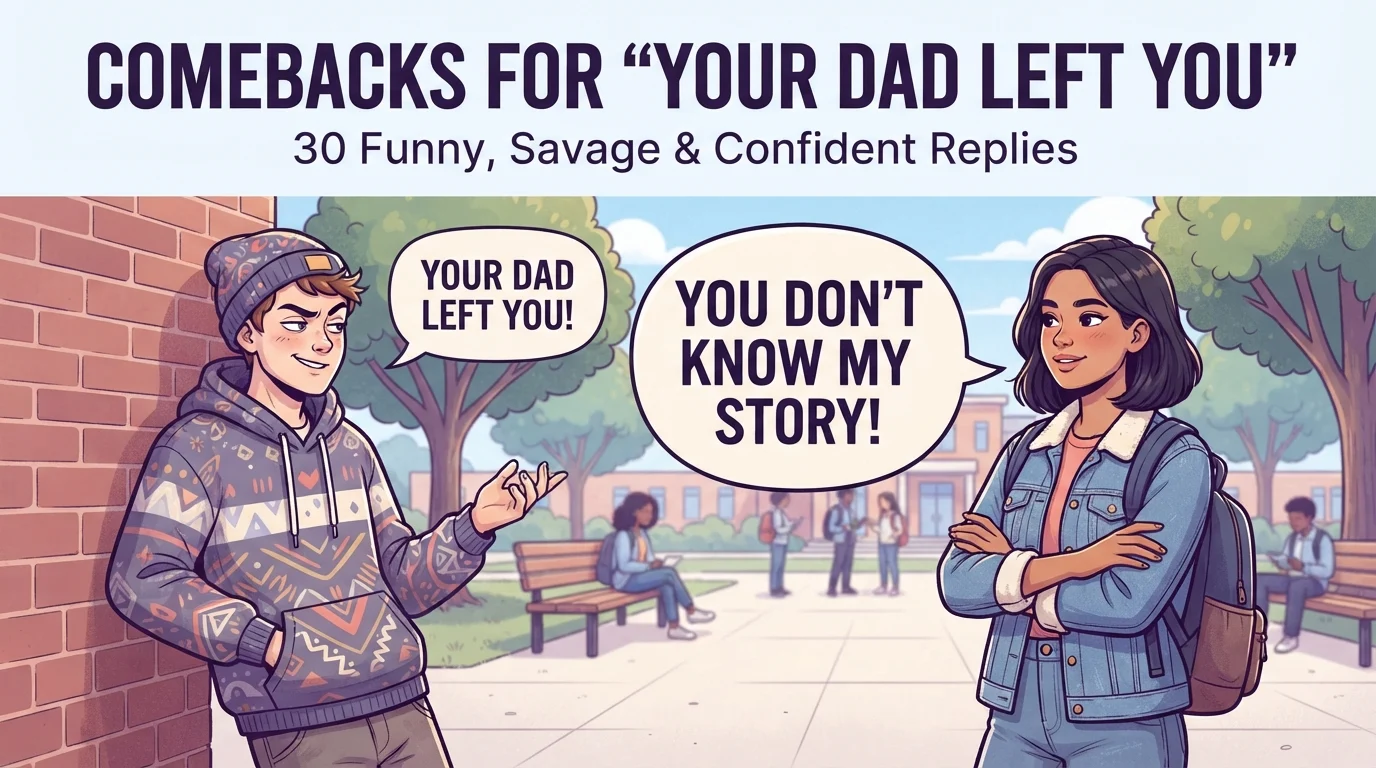
Hearing someone say “your dad left you” can be hurtful, especially when they use it to embarrass you, make fun of your family, or get a reaction. Whether the comment comes from a classmate, a friend, an online troll, or someone during an argument, knowing how to respond can help you protect your confidence without letting the situation control your emotions.
The best comebacks for the “your dad left you” comment depend on the situation and how you want to handle it. You might prefer a funny one-liner to shut down a rude joke, a savage comeback to show that you won’t be intimidated, or a calm response that sets a clear boundary. These 30 replies give you different ways to respond with wit, self-respect, and confidence—without feeling pressured to share private details about your family.
1. “And You Still Couldn’t Find a Better Joke?”
This comeback points out how unoriginal the comment is without requiring you to explain your personal life. It works especially well when someone is trying to get attention by making a hurtful joke.
Best for: Responding to classmates, friends, or people who make immature jokes.
Alternative: “That’s the best you’ve got?”
Examples:
- “And you still couldn’t find a better joke?”
- “You had all that time to think, and that’s what you came up with?”
2. “My Life Isn’t Your Comedy Show”
Sometimes people treat personal struggles as entertainment. This response makes it clear that your family situation isn’t something they get to use for laughs.
Best for: When someone repeatedly makes personal jokes about your family.
Alternative: “Find something else to joke about.”
Examples:
- “My life isn’t your comedy show, so find another topic.”
- “My family isn’t here for your entertainment.”
3. “At Least I Don’t Make Fun of People’s Families”
This comeback shifts attention to the other person’s behavior rather than your personal circumstances. It highlights the difference between having a difficult experience and choosing to mock someone.
Best for: When you want to make a strong point without using an insult.
Alternative: “Making fun of someone’s family says more about you than them.”
Examples:
- “At least I don’t use someone’s family situation to get laughs.”
- “I could make personal jokes too, but I prefer having manners.”
4. “That’s a Pretty Low Blow”
A simple, direct response can sometimes be more effective than a clever insult. This one tells the person that their comment crossed a line.
Best for: Serious conversations when someone you know makes a hurtful remark.
Alternative: “That was unnecessary.”
Examples:
- “That’s a pretty low blow. Do better.”
- “You can disagree with me without bringing my family into it.”
5. “You Don’t Know My Story”
People often make assumptions about someone else’s family without knowing the facts. This comeback reminds them that they don’t have the full picture.
Best for: Responding to people who make assumptions about your family.
Alternative: “Don’t pretend you know my life.”
Examples:
- “You don’t know my story, so stop acting like you do.”
- “You know one detail, not my entire life.”
6. “Imagine Being This Interested in My Family”
This witty response makes the other person’s obsession with your personal life the focus of the joke.
Best for: Casual arguments and playful but sharp exchanges.
Alternative: “My family seems to be taking up a lot of space in your mind.”
Examples:
- “Imagine being this interested in someone else’s family.”
- “You talk about my family more than I do.”
7. “That’s Not the Insult You Think It Is”
This comeback communicates that the person hasn’t achieved the reaction they wanted. It can help you maintain your composure instead of becoming defensive.
Best for: When someone is clearly trying to provoke you.
Alternative: “You’re going to have to try harder than that.”
Examples:
- “That’s not the insult you think it is.”
- “You expected that to hurt more than it did, didn’t you?”
8. “My Worth Doesn’t Depend on My Family Situation”
This confident reply brings the conversation back to what matters: your value as a person. It is especially useful when the comment touches a sensitive subject.
Best for: Moments when you want to respond seriously and confidently.
Alternative: “My circumstances don’t define who I am.”
Examples:
- “My worth doesn’t depend on who stays in my life.”
- “My family situation doesn’t determine the kind of person I become.”
9. “You Really Need New Material”
If someone keeps repeating the same comment, humor can help you dismiss the attempt without giving it much attention.
Best for: Repeated teasing from peers or online commenters.
Alternative: “That joke expired a long time ago.”
Examples:
- “You really need new material. That one’s getting old.”
- “Same joke again? Even your insults are on repeat.”
10. “Why Are You So Comfortable Being Cruel?”
This question encourages the person to consider their behavior. It can be more powerful than returning the insult because it asks them to explain their choice.
Best for: When someone deliberately targets a sensitive personal subject.
Alternative: “What makes you think that’s an acceptable thing to say?”
Examples:
- “Why are you so comfortable using someone’s family to hurt them?”
- “Do you actually think that makes you funny?”
11. “I’m Not Embarrassed by My Story”
A person’s family circumstances are not a measure of their worth or character. This response shows that you don’t accept the shame someone is trying to place on you.
Best for: Responding confidently to personal attacks.
Alternative: “My past isn’t something you get to use against me.”
Examples:
- “I’m not embarrassed by my story, and I’m not explaining it to you.”
- “My life isn’t perfect, but I don’t owe you an apology for it.”
12. “That’s a Weird Thing to Be Proud Of”
This sharp response works when the other person seems proud of making a hurtful comment. It questions their behavior without requiring you to reveal anything personal.
Best for: When someone brags about getting under your skin.
Alternative: “Congratulations on being unnecessarily mean.”
Examples:
- “That’s a weird thing to be proud of.”
- “If hurting people is your achievement, aim higher.”
13. “You Can Roast Me Without Bringing My Family Into It”
Roasting can be funny when everyone is comfortable with the jokes. This response makes it clear that some subjects are off-limits.
Best for: Friend groups where teasing is common but a joke goes too far.
Alternative: “Keep the jokes about me, not my family.”
Examples:
- “Roast my outfit or my haircut, but leave my family out of it.”
- “There’s a difference between funny teasing and getting personal.”
14. “I’m More Than One Thing That Happened in My Life”
This thoughtful response reminds the other person that your identity is much bigger than a family circumstance.
Best for: Responding to a hurtful comment when you want to stay grounded.
Alternative: “One part of my life doesn’t define all of me.”
Examples:
- “I’m more than one thing that happened in my life.”
- “You don’t get to reduce my entire story to one detail.”
15. “Thanks for Showing Everyone Your Character”
Sometimes the strongest reply is one that exposes the unkindness of the comment rather than attacking the person back.
Best for: Public arguments or situations where other people witness the remark.
Alternative: “Your words say enough about your choices.”
Examples:
- “Thanks for showing everyone how you treat people.”
- “I don’t need to insult you back. Your comment speaks for itself.”
16. “Do You Want a Reaction That Badly?”
Some people make personal remarks because they want to see you get upset. This question challenges that behavior and helps you avoid giving them the response they want.
Best for: Trolls, attention-seekers, and people who deliberately provoke others.
Alternative: “I’m not giving you the reaction you’re looking for.”
Examples:
- “Do you want a reaction that badly?”
- “You seem determined to upset me, but it’s not working the way you hoped.”
17. “Let’s Talk About Something You Actually Know”
This sarcastic comeback challenges the person’s assumption that they understand your personal life. Use it when a sharp response fits the situation.
Best for: Someone making confident but uninformed comments about your family.
Alternative: “Maybe stick to facts instead of assumptions.”
Examples:
- “Let’s talk about something you actually know.”
- “You seem very confident about a story you weren’t part of.”
18. “My Future Is Bigger Than Your Opinion”
This motivational response shifts attention away from the insult and toward your own goals and decisions.
Best for: When you want to respond positively instead of trading insults.
Alternative: “Your opinion doesn’t decide my future.”
Examples:
- “My future is bigger than your opinion of my family.”
- “I’m focused on building my life, not proving myself to you.”
19. “That’s Personal, Not Funny”
This short reply clearly separates humor from a personal attack. It is especially effective when you want the person to understand why the comment is inappropriate.
Best for: School, work, or social settings where you need a direct boundary.
Alternative: “Not every personal issue is a joke.”
Examples:
- “That’s personal, not funny. Find another joke.”
- “If the joke depends on hurting someone, it isn’t that clever.”
20. “You Don’t Get to Define My Family for Me”
This firm response is useful when someone makes assumptions about your relationships or family history.
Best for: People who repeatedly comment on your family situation.
Alternative: “My relationships aren’t yours to judge.”
Examples:
- “You don’t get to define my family for me.”
- “You don’t know the full situation, and you don’t need to.”
21. “I Hope You Never Have to Understand That Feeling”
This empathetic but firm response communicates that the topic may involve real pain. It can encourage someone to think twice about making similar comments.
Best for: When the remark touches a genuinely sensitive experience.
Alternative: “I wouldn’t wish that kind of pain on anyone.”
Examples:
- “I hope you never have to understand why that comment hurts.”
- “I wouldn’t wish anyone’s family struggles on them, so don’t use mine as a joke.”
22. “That’s Your Opinion, Not My Identity”
This response reminds the person that their judgment does not determine who you are.
Best for: When someone tries to label or define you through your family circumstances.
Alternative: “You can have an opinion without making it my identity.”
Examples:
- “That’s your opinion, not my identity.”
- “You can say what you want, but it doesn’t decide who I am.”
23. “If You Have a Problem With Me, Say It Directly”
Sometimes people bring up family matters because they want to hurt you during an unrelated disagreement. This response asks them to address the real issue.
Best for: Arguments where someone uses personal information to attack you.
Alternative: “Keep the conversation about the actual problem.”
Examples:
- “If you have a problem with me, talk about me instead of my family.”
- “Tell me what I did wrong without dragging personal matters into it.”
24. “I’m Not Going to Explain My Family to You”
You have the right to keep private matters private. This reply protects your boundaries without making excuses or sharing details you would rather keep personal.
Best for: Acquaintances, classmates, online users, or anyone who demands an explanation.
Alternative: “That’s not something I’m discussing with you.”
Examples:
- “I’m not going to explain my family situation just to satisfy your curiosity.”
- “My personal life isn’t up for debate.”
25. “You Can Be Funny Without Being Hurtful”
This response works when you want to explain the difference between harmless humor and insulting someone about a sensitive subject.
Best for: Friends who cross the line while joking around.
Alternative: “Try being funny without making it personal.”
Examples:
- “You can be funny without making someone else’s family the punchline.”
- “A good joke doesn’t need to make someone feel small.”
26. “I’m Choosing Peace Over This Conversation”
Not every insult deserves a comeback. Sometimes stepping away is the clearest way to protect your peace and avoid escalating a conflict.
Best for: Arguments that are becoming repetitive, hostile, or emotionally draining.
Alternative: “I’m done discussing this with you.”
Examples:
- “I’m choosing peace over arguing about my family.”
- “This conversation isn’t going anywhere, so I’m walking away.”
27. “Say It Again When You Have Something Intelligent to Add”
This sharp comeback challenges the quality of the comment rather than the person’s family or appearance. It is best reserved for situations where a firm, sarcastic response is appropriate.
Best for: Verbal sparring with someone who is deliberately trying to provoke you.
Alternative: “Bring an actual point next time.”
Examples:
- “Say it again when you have something intelligent to add.”
- “If that’s your entire argument, I think we’re finished here.”
28. “I Know What I Bring to This World”
This self-assured response reminds you and the other person that your value comes from your own character, choices, and actions.
Best for: When you want a positive, empowering response to a personal attack.
Alternative: “I know who I am, regardless of your opinion.”
Examples:
- “I know what I bring to this world, and your comment won’t change that.”
- “I’m building a life I’m proud of, and that’s what matters.”
29. “That Comment Says More About You Than Me”
This classic comeback focuses on the decision to make a hurtful remark. It can help you avoid being pulled into a long argument.
Best for: Responding to insults in person or online.
Alternative: “Your choice of words reflects your behavior.”
Examples:
- “That comment says more about you than it ever will about me.”
- “I’m not responsible for your decision to turn something personal into an insult.”
30. “I’m Not Going to Let Your Words Define Me”
This confident response is a strong way to end a conversation. It acknowledges the comment without accepting the meaning the other person is trying to attach to it.
Best for: Serious situations where you want to stand up for yourself and move forward.
Alternative: “Your words don’t determine my worth.”
Examples:
- “I’m not going to let your words define me or my future.”
- “You can make your comments, but I decide how I see myself.”
FAQs
1. What is the best comeback for “Your dad left you”?
A strong response is, “You don’t know my story, so stop acting like you do.” It protects your privacy and challenges the person’s assumption without requiring you to share personal details. If the comment is meant to hurt you, you can also say, “That’s a low blow. Do better.”
2. What is a funny reply when someone says your dad left you?
You could say, “You really need new material,” or “And you still couldn’t find a better joke?” These responses work best when you want to dismiss an immature comment without turning the exchange into a serious argument.
3. How do I respond when someone makes fun of my family?
Stay calm, set a clear boundary, and avoid sharing private information unless you genuinely want to. You can say, “My family isn’t your comedy show,” or “You can disagree with me without bringing my family into it.”
4. What should I say if the comment actually hurts my feelings?
You don’t have to pretend that a painful comment doesn’t affect you. Try saying, “That’s personal, and I don’t appreciate you using it against me.” You can also step away, talk to someone you trust, or ask for support if the comments continue.
5. Should I use a savage comeback or ignore the comment?
Choose based on the situation. A witty reply can work during casual banter, while a direct boundary is better when someone is deliberately cruel. Ignoring the comment or walking away can be the strongest choice if the person is only trying to provoke you or the situation could become unsafe.
Conclusion
Finding the right comebacks for the “your dad left you” comment can help you respond to personal insults without losing your confidence. Whether you choose a funny one-liner, a sharp comeback, or a calm statement about boundaries, remember that you don’t owe anyone an explanation of your family circumstances.
Your family story does not determine your value, and someone else’s attempt to embarrass you does not define who you are. Choose a response that protects your self-respect, avoid escalating the situation unnecessarily, and walk away when a conversation becomes cruel. Sometimes the most powerful comeback is showing that you know your worth without needing the other person to recognize it.

I am Alex James, the Administrator of Replieds. I help create useful, thoughtful, and engaging reply ideas that make conversations easier, more natural, confident, and meaningful for everyone.